
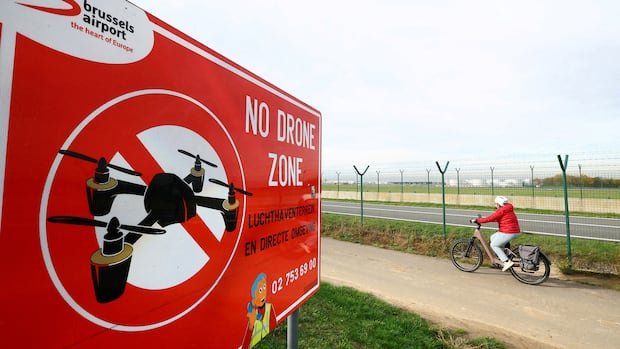

Belgium was on high alert even before three drones were reportedly sighted over a power plant in the northern part of the country on Sunday evening. A series of drone sightings has led to the closure of airports in Belgium, causing travel disruptions for thousands of passengers and grounding flights. This incident is part of a pattern of mysterious drone activities occurring across Europe, targeting airports and military installations, with some officials implicating Russia. Authorities are working urgently to enhance their defense mechanisms.
Reports from Belgian media indicate that the drones were spotted over the Doel nuclear power plant near the Port of Antwerp over the weekend. However, these reports are yet to be confirmed. Unlike the well-documented Russian drone incursions into Polish airspace in September, there is limited information available about the recent drone sightings.
According to Jacob Funk Kirkegaard, a senior fellow at the Peterson Institute and Bruegel, the drones involved in the recent incidents have not been intercepted or crashed. He described the situation as a game of “whack-a-mole” or hide-and-seek, highlighting the challenge of tracking and stopping these drones that quickly enter and leave restricted airspaces.
In response to the escalating drone threat, Britain announced sending experts and equipment to assist Belgium in detecting and defending against drones. The closures at Brussels airport and Liège Airport in Belgium have prompted heightened security measures. Similarly, in Germany, authorities are forming rapid-response teams to counter drone threats, which have been attributed to Russia by the country’s defense minister.
Meanwhile, Russian spokesperson Dmitry Peskov dismissed accusations of Russia’s involvement in launching the drones, attributing the blame to European politicians seeking to blame Russia for various issues. The frequency of drone sightings has raised concerns, with countries supporting Ukraine or considering such support being particularly targeted.
Following the violation of Polish airspace by Russian drones, NATO introduced the Eastern Sentry mission to increase aerial patrols in Poland. Surveillance aircraft equipped with advanced radar systems are being deployed to enhance monitoring capabilities. Efforts are underway to adapt surveillance systems to detect smaller drones effectively, as conventional radar systems may not detect them adequately.
European Union officials are now aiming to establish a region-wide “drone wall” by 2027 to address the escalating drone threats. Lessons from conflict zones like Ukraine emphasize the challenges of countering swarms of agile and cost-effective drones. European countries are urged to prioritize safeguarding critical infrastructure and make informed decisions regarding intervention measures to mitigate risks effectively.