
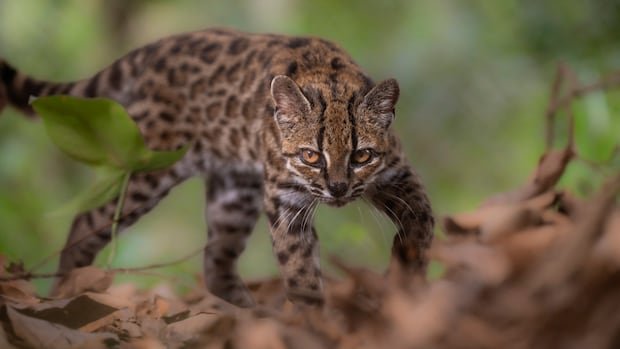

A small wild cat species living in Bolivia’s cloud forest has been officially recognized as a new species after more than a century without a new designation for a living cat species. Referred to as Tilcayo by local communities, this cat belongs to a group known as tiger cats found in various parts of South America. Discovered in Bolivia’s Yungas forest, a region characterized by misty forests and high humidity, the cat is approximately 46 centimeters (18 inches) long and weighs around three pounds, making it smaller than the average house cat.
Genetic research confirmed the cat’s status as a new species, and it was given the scientific name Leopardus tilcayo while retaining its local title. The cat’s fur is light brown with rosettes irregularly spread across its body, as described by Paola Nogales Ascarrunz, a National Geographic explorer and study co-author.
The cat’s biology and behavior remain largely unknown, with indications from scat samples suggesting a diet including small rodents and camera-trap footage implying nocturnal activity. Tiger cats are considered cryptic species that cannot be easily distinguished based on appearance alone, according to Jonas Lescroart, an evolutionary biologist and co-lead author of the study.
The research team identified only two live individuals of the new species, one of which is a male residing in the Senda Verde Wildlife Sanctuary after being kept by a local family. The team’s genetic analysis of tiger cats across South America revealed five genetically distinct species, including the newly identified Bolivian cat.
The study also introduced a new tiger cat subspecies in Peru’s Yungas, named Leopardus tigrinus antisuyo after the historical region of Antisuyu within the Inca Empire. The International Union for Conservation of Nature (IUCN) currently classifies tiger cats as two “vulnerable” species, but the researchers have submitted their findings for a more detailed assessment by the IUCN.
The urgency of accurate assessments is emphasized in the Yungas due to threats from deforestation, agriculture, fires, and mining activities. Conservation efforts such as restoring damaged forest patches, safeguarding native forests, and maintaining habitat connections are critical to preserving these unique species in the face of environmental challenges.