
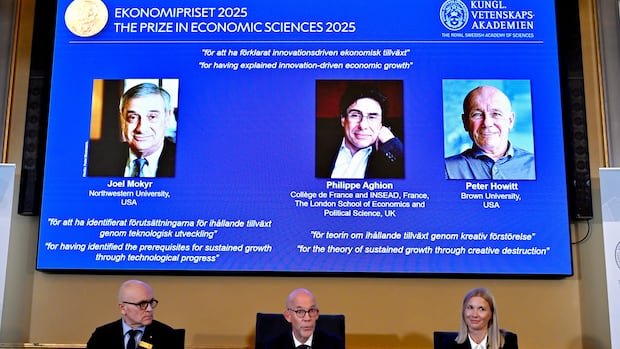

Canadian economist Peter Howitt, along with researchers Joel Mokyr and Philippe Aghion, have been awarded the Nobel Memorial Prize in Economics by the Royal Swedish Academy of Sciences. Their research focuses on the impact of innovation on economic growth and the concept of “creative destruction,” where new technologies replace older ones.
Howitt, Mokyr, and Aghion offer different yet complementary perspectives on economics. Mokyr, an economic historian, analyzes long-term trends using historical data, while Howitt and Aghion utilize mathematical models to explain the workings of creative destruction.
Howitt, 79, holds degrees from McGill University and Western University and is currently a professor at Brown University. Aghion, 69, is affiliated with the College de France and the London School of Economics, while Mokyr, 79, is from Northwestern University.
Upon learning of the prestigious award, Howitt expressed his excitement, calling it a “dream come true.” He was informed by a Swedish reporter before the official announcement, which led to a flurry of phone calls and celebrations.
The trio’s research sheds light on the concept of creative destruction, a fundamental economic principle first introduced by economist Joseph Schumpeter. Their work emphasizes the importance of innovation and scientific understanding in driving sustained economic growth.
Aghion and Howitt’s collaboration has not only contributed to economic theory but also influenced policy-making. Aghion advised French President Emmanuel Macron on economic matters, while Howitt criticized protectionist trade policies and emphasized the significance of global cooperation for innovation.
The Nobel Prize in Economics, though not part of the original Nobel Prizes, is a prestigious recognition. The laureates, who receive half of the 11 million Swedish kronor prize each, are honored for their groundbreaking contributions to understanding economic growth and innovation.