
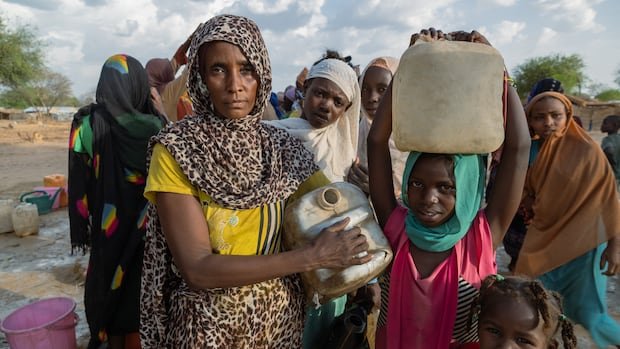

Under a makeshift shelter, Nahma Mohammed recounts her harrowing eight-day journey from Nyala in Sudan’s Darfur region to seek refuge in Birao, Central African Republic, amid scorching midday temperatures. “The journey was incredibly challenging… filled with thieves, armed individuals, and weapons everywhere,” she shared, gently bouncing her youngest child on her lap. “It felt like navigating a thin line between life and death.”
She is among numerous new arrivals waiting in the dusty surroundings, eager to have their pictures taken and fingerprints scanned, adding to the 22,000 residents of the Korsi Refugee camp and the 4.4 million Sudanese displaced across various borders. Three years after the eruption of conflict in Sudan in April 2023, the nation grapples with what the United Nations now labels as the most severe displacement crisis globally, with over 11 million people uprooted from their homes.
The initial clash between two military figures – Sudanese army chief Gen. Abdel Fattah al-Burhan and RSF leader Mohamed Hamdan Dagalo – has since evolved into a convoluted conflict. Presently, the army (SAF) exerts control over significant portions of the east and center of the country, while RSF forces dominate vast regions in the west, notably Darfur. The deliberate targeting of civilian infrastructure such as hospitals and the escalating use of drone warfare have fostered a perilous environment for civilians.
As per the IFRC, an estimated 33 million individuals require assistance, with global humanitarian and development funds witnessing reductions. UN approximations suggest a death toll of 40,000, though many suspect the actual figure could be significantly higher.
The population of Birao has surged due to an influx of refugees crossing the border. The journey to the camp from the border point at Am Dafok spans 65 kilometers through a region still volatile due to RSF and local armed militia presence.
Upon arrival in this secluded region, refugees are met with limited resources. The Central African Republic stands as one of the world’s poorest nations, with nearly seven out of 10 individuals surviving on less than $2.15 US per day. Hikmah Hussain, an early refugee arrival in 2023, vividly recounts the incident that propelled her flight from Nyala – the tragic loss of her sister to a bombing.
Before her escape, Hussain worked with the Sudanese Red Crescent in Darfur, experiencing the chaos of the initial conflict weeks. She vividly recalls the terror of escaping RSF fighters seizing their vehicle, compelling them to seek refuge in a hospital among airstrike casualties, eventually fleeing amidst pandemonium.
In the camp, long queues of women await their turn at water points, highlighting the scarcity of potable water. Refugees navigate the camp’s tents, requesting essentials like food, water, soap, and clothing, which have become increasingly scarce. Early in the conflict, aid was more accessible to refugees, but dwindling assistance has become a pressing concern.
NGO Oxfam notes a significant reduction in U.S. funding for the refugee response, while internal Sudanese humanitarian funding has seen declines. The escalating needs, with 21.2 million individuals facing acute food shortages, underscore the ongoing crisis.
Multiple civil society organizations have reported widespread atrocities in Sudan, including sexual violence and beheadings. However, in Birao, essential services supporting gender-based violence survivors have shuttered due to aid cuts, raising worries about the conflict’s enduring psychological impact.
Gloria Ramazani from UNHCR’s Central African Republic office highlights the adverse effects of funding shortfalls on camp residents, exacerbating hunger, disease risks, and vulnerability to violence. The limited resources in Birao, compounded by the area’s remoteness and inadequate services, pose challenges to aid efforts, escalating the crisis’s complexities.
Hussain, now a community leader among women in Birao, symbolizes the refugee-led initiatives emerging to bridge aid gaps amidst dwindling international support. However, these informal networks face threats due to funding shortages across the humanitarian and development sectors.
As financial backing diminishes, the conflict in Sudan shows no signs of abating. Drone warfare’s escalating use has broadened the conflict’s scope and lethality, with external actors like the United Arab Emirates accused of fueling the conflict through arming rival factions, intensifying regional ramifications.
Marie-Helene Verney, UNHCR’s Sudan representative, paints a complex picture of ongoing conflict across various Sudanese regions, noting increased aerial bombardments and drone attacks. The war’s persistence and resultant displacements continue unabated, underscoring the urgent need for sustained international support to alleviate the crisis’s impacts.
Inside the lone hospital in Birao, Taiba Ahmat Kamiss cradles her newborn, reflecting on her family’s uncertain future after fleeing Sudan in 2024. The challenges faced by refugees like Kamiss underscore the imperative for continued aid efforts to