
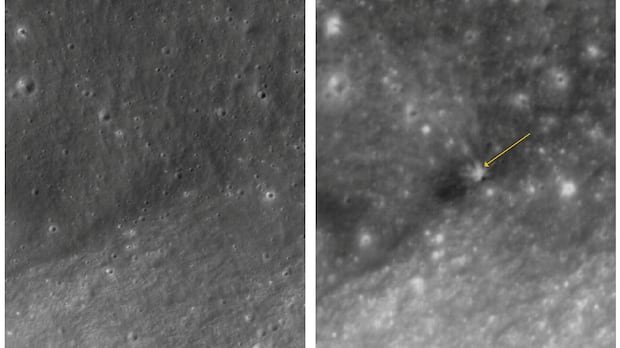

A satellite from South Korea has captured images of a mark on the moon caused by a SpaceX rocket collision. The visible evidence is a noticeable smudge that varies in darkness and lightness in different photos, located near the Einstein Crater on the moon’s surface. The Korean lunar orbiter Danuri, also known as the Korean Pathfinder Lunar Orbiter (KPLO), obtained images before and after the SpaceX Falcon 9 upper stage crashed into the moon while en route, as reported by the Korean AeroSpace Administration (KASA) on X. The high-resolution Lunar Terrain Imager (LUTI) camera on the orbiter captured these images.
The incident involved the second stage of a SpaceX rocket that launched in January 2025, carrying two lunar landers. After a year of drifting off-course, the rocket stage made an unintentional but expected impact on the moon at a speed of approximately 8,700 km/hour on Wednesday. Telescopes on Earth observed the resulting debris plume, confirming the crash even before the release of the new images.
Danuri, launched on a SpaceX rocket in 2022, has been orbiting around 100 kilometers above the moon’s poles since December of that year. Originally planned for a one-year mission, its operational lifespan has been extended until 2027.
The event has raised questions about responsibility for space debris, with scientists eager to study the implications of the SpaceX rocket piece colliding with the moon. University of Montreal astrophysicist Nathalie Ouellette highlights the significance of understanding the impact and emphasizes the need for commercial space companies to manage post-mission debris responsibly.