
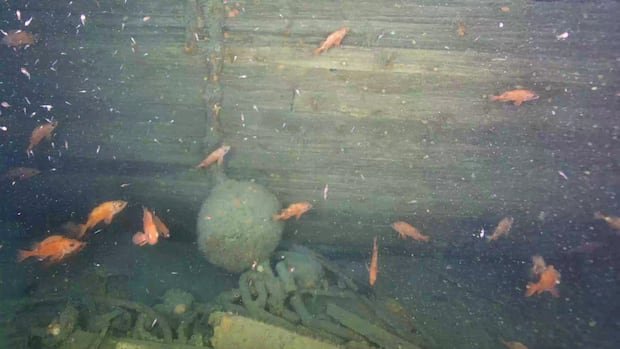

An exploration at a depth of nearly 400 meters below the Labrador Sea has unveiled the initial images of Quest, the vessel that transported renowned Antarctic explorer Sir Ernest Shackleton on his last journey. The Royal Canadian Geographical Society (RCGS) deployed a remotely operated vehicle (ROV) to capture visuals of the sunken ship’s location off the Labrador coast in 1962. Exclusive access to the expedition was granted to CBC News aboard the research vessel Atlantis, where the first images displayed the ship’s stern entangled in fishing equipment.
David Mearns, the co-chief scientist of the mission and an expert shipwreck locator with 29 discoveries to his credit, expressed concern over the damage caused by the fishing nets on the wreck. The Quest wreck was initially identified by the RCGS using side-scan sonar two years ago. The expedition, which involved a significant financial investment, aimed to obtain imagery of the wreck.
The RCGS collaborated with the Woods Hole Oceanographic Institution from Massachusetts to investigate two shipwrecks in the Labrador Sea. John Geiger, the RCGS CEO and expedition leader, personally participated in the initial dive to the wreck aboard the submersible Alvin. The history of Quest dates back to its acquisition by Shackleton for exploration in Northern Canada before he redirected it to Antarctica due to the lack of Canadian government support.
After serving various purposes post-World War II, including as a minesweeper and seal hunting vessel, Quest sank in 1962 off Labrador’s southern coast. Although the crew survived, the ship’s cargo of seal pelts was lost. Despite the damage caused by fishing activities, the research director confirmed the wreck’s identity based on distinctive features matching historical records.
The expedition also plans to generate a digital replica of the wreck using advanced 3D imaging technology. The presence of fishing nets obstructing the starboard side has complicated efforts to capture detailed imagery. The team discovered the wreck in 2024 and hopes the expedition will shed light on the condition of the wreck, changes over time, and the insights that can be gained from the debris field surrounding it.
Following investigations on Quest, the expedition will proceed to explore another wreck, Terra Nova, located at the southern tip of Greenland. Originally owned by the Bowring Company, the ship was famously utilized by Robert Falcon Scott during his ill-fated South Pole expedition in 1912.