
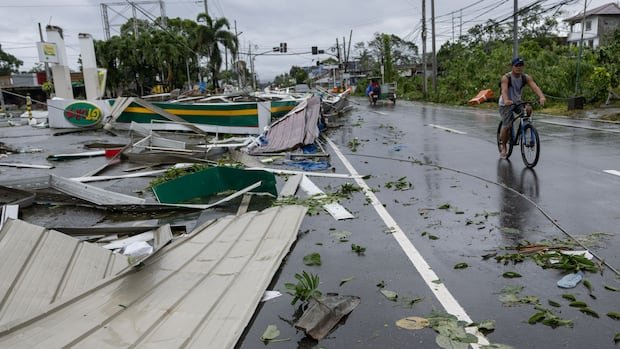

Typhoon Fung-wong has exited the northwestern Philippines, causing floods and landslides, leading to power outages in entire provinces. The disaster resulted in at least eight fatalities and forced over 1.4 million people to evacuate. The typhoon is expected to move northwest towards Taiwan.
Fung-wong struck the northern Philippines while the region was still recovering from Typhoon Kalmaegi’s aftermath, which claimed the lives of 224 individuals in central provinces before hitting Vietnam, where five people perished.
The super typhoon made landfall in northeastern Aurora province with sustained winds reaching 185 kilometers per hour and gusts up to 230 kilometers per hour. As it moved through mountainous northern provinces and agricultural areas, the storm weakened before heading into the South China Sea.
Fatalities were reported due to the disaster, including drownings in flash floods, collapsed houses, and landslides in various provinces. Emergency shelters housed over 1.4 million individuals, with approximately 318,000 still in evacuation centers as of Monday. The storm caused severe damage to villages, leaving some residents stranded on rooftops.
Philippine President Ferdinand Marcos Jr. declared a state of emergency due to the extensive devastation caused by consecutive typhoons. The country categorizes storms with sustained winds of 185 kilometers or higher as super typhoons.
Despite the destruction, the Philippines has not requested international assistance. However, the United States and Japan stand ready to offer aid. Schools and government offices were closed, and numerous flights and sea voyages were canceled due to the severe weather conditions.
The Philippines faces numerous natural calamities yearly, including typhoons, earthquakes, and volcanic eruptions, making it one of the most disaster-prone countries globally.