

Adriana Avelina Ruíz Márquez utilizes counterfeit eyelash adhesive to affix a small transmitter to the thorax, just behind the head, of the monarch butterfly. Weighing approximately half a gram, the butterfly effortlessly carries the 60-milligram device, which incorporates a solar panel the size of a grain of rice. Following the intricate procedure, which additionally involves a toothpick and a Q-Tip, the butterfly flutters its wings and swiftly takes flight after Ruíz Márquez, a deputy director for the Monarch Butterfly Biosphere Reserve, releases it.
Ruíz Márquez expressed confidence that this innovative tracking device—deployed in Mexico for the first time to tag monarchs before their migration back north to the U.S. and southern Canada—will aid in unraveling some enigmas surrounding the insects, including utilizing people’s smartphones to monitor their movements. “There is a lot of mystery to their route of migration, their activity when they arrive, when they leave,” she remarked.
The vast majority of North America’s monarchs east of the Rocky Mountains overwinter in El Rosario, situated in the state of Michoacán about 180 kilometers west of Mexico City. This location is one of the six sanctuaries comprising the Monarch Butterfly Biosphere Reserve, which spans across Michoacán and the State of Mexico, encompassing a core protected area of roughly 135 square kilometers.
Teams from the federal Commission for National Natural Protected Areas and World Wildlife Fund (WWF) Mexico have tagged a total of 160 monarchs across the reserve, including 40 in El Rosario, with the new transmitter. According to Eduardo Rendón Salinas, a biologist with WWF Mexico, this initiative will offer the most comprehensive insight to date into the initial phase of the butterflies’ northward migration.
It typically takes three to four generations of monarchs to complete the journey north, covering up to 5,000 kilometers. The so-called super generation of monarchs, emerging in late summer from the Prairies to the Maritimes and down through the U.S. Northeast and Midwest, completes the southward journey in a single flight. They mate in sanctuaries like El Rosario before heading north again, depositing the next generation of eggs along the way.
The new microchipped transmitter emits a signal detectable by nearby iPhones to crowdsource the trajectory of the butterflies, provided that the devices have Bluetooth and location functions enabled. This functionality allows the Project Monarch app, accessible to all, or a handheld receiver to map out the butterflies’ route. David La Puma, director of global market development at New Jersey-based Cellular Tracking Technologies, the device developer, touted the enhanced spatial detail now available for monitoring butterfly movements.
Previously, scientists relied on wing tags attached to monarchs, revealing limited information about their movements during migration. La Puma mentioned ongoing developments to upgrade the transmitter, enabling Android smartphones to serve as passive detectors.
Following successful trials in 2023 and 2024, the transmitters were integrated into a continent-wide monarch tracking project involving over 20 groups. The project commenced in Ontario in September 2025, with the participation of Environment and Climate Change Canada and Birds Canada. By October, a total of 400 monarchs had been tagged from Canada to Cuba, tracking their entry into Mexico’s Monarch Butterfly Biosphere Reserve in November.
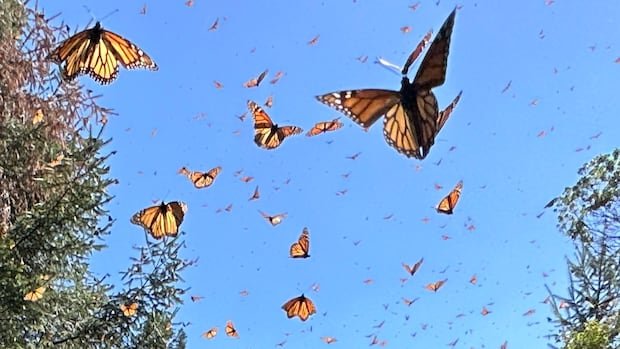
During the period between November and March, the reserve transforms into the butterflies’ empire. The monarchs form massive clusters on the oyamel branches, sometimes causing branches to snap under their weight. A community patrol, including Horacio Cruz Guzmán, safeguards the area from illegal logging.
The sanctuary, located in the El Rosario ejido—a collectively held community land, is protected and managed by the locals. The community has established a thriving tourism business operating during the approximately five months the monarchs spend in the sanctuary, offering a vital income source. Additionally, they cultivate oyamel seedlings to preserve the forest’s health, demonstrating their commitment to conservation and appreciation for the natural wonder of the monarch butterfly.