


Experts warn of the potential danger posed by asteroids, emphasizing the importance of humanity’s capability to divert them if they pose a threat to Earth.
Asteroids come in various sizes, leading to different impacts — ranging from small objects creating spectacular fireballs and loud sonic booms to large space rocks capable of causing global devastation and even extinction events.
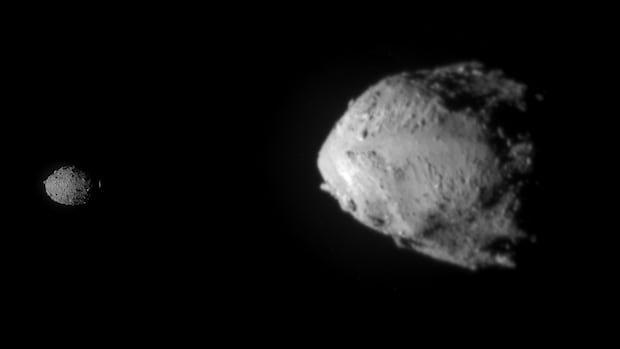
In 2022, NASA’s Double Asteroid Redirection Test (DART) spacecraft deliberately collided with Dimorphos, a small moon orbiting the larger asteroid Didymos, after a 10-month journey to the binary asteroid system.
The successful mission, conducted approximately 11 million kilometers from Earth, resulted in a significant reduction of Dimorphos’s orbit around Didymos by about 32 minutes. Additionally, a recent study published in Science Advances revealed that the collision also slightly modified the pair’s trajectory around the sun.
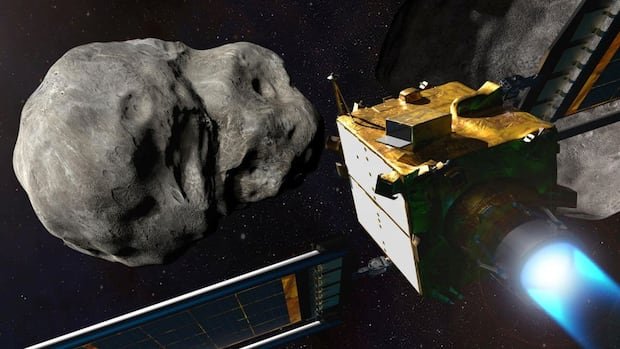
NASA’s unmanned spacecraft collided with an asteroid as part of a groundbreaking test to prepare for the potential threat of a catastrophic asteroid impact. Although the targeted asteroid was not a direct threat, the test aimed to assess NASA’s capability to deflect such a danger.
Rahil Makadia, the study’s lead author and a planetary defense scientist from the University of Illinois Urbana-Champaign, hailed the findings as a significant advancement in safeguarding our planet.
According to Makadia, a slight nudge given well in advance could potentially redirect a hazardous asteroid away from Earth without the need to destroy it.
Reasons for targeting a binary asteroid system
While some asteroids exist independently, many have satellite moons, and some are part of binary or triple systems, where multiple bodies orbit each other in space.
Derek Richardson, emeritus professor of astronomy at the University of Maryland, explained that the DART mission focused on a binary system deliberately because it is easier to observe the orbital changes in such systems.