
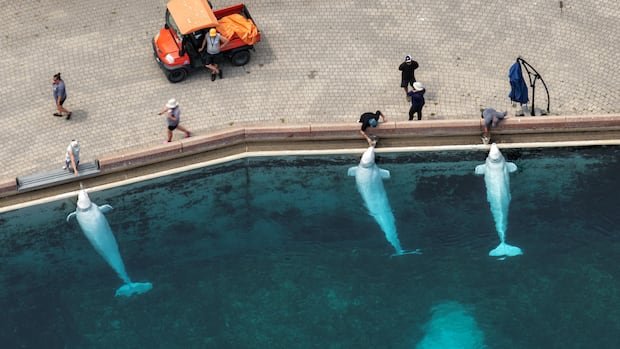

Earlier in the current month, a plan was officially sanctioned by the federal government that could see the 30 beluga whales residing at the now-closed Marineland in Niagara Falls, Ont., being relocated to various international locations.
Due to a law passed in 2019 in Canada prohibiting the keeping of whales, dolphins, and porpoises for breeding or entertainment purposes, the belugas cannot be transferred to another Canadian aquarium. Instead, it is anticipated that the whales will be divided between an aquarium in Spain and four facilities in the United States.
With these marine mammals reaching lengths of up to 4.5 meters and weighing as much as 1,900 kilograms, the logistics of transporting them to their new homes are complex. Although detailed information from the destination aquariums managing the rescue operation is still pending, insights from experts experienced in whale transportation shed light on the process.
Step 1: The initial phase involves obtaining the necessary permits from the Canadian government and the recipient countries for the belugas’ relocation. Decision-making on each whale’s destination is influenced by their individual characteristics assessed by trainers. Prior to travel, the belugas undergo health assessments, bloodwork, and other vet checks.
While governmental approval has been granted in Ottawa, additional logistical steps and permits are required before the belugas can be transferred, as explained by Johnny Ford, the VP of communications at the potential recipient Shedd Aquarium.
Step 2: Trainers dedicate months to acclimating the belugas to the equipment used to lift them from their tanks. The animals are lifted using a specially designed sling and stretcher. Familiarizing the belugas with the sling can take time based on their distinct personalities.
Step 3: On the day of travel, the belugas are raised from their tanks using slings and placed into custom transport crates equipped with stretchers. These crates are spacious enough for the animals to move comfortably and are filled with water at appropriate levels to ensure their well-being during transit.
Step 3: The transport crates are then transported by truck to a cargo plane, accompanied by a crew of trainers and veterinarians monitoring the belugas’ well-being throughout the flight.
Step 4: Upon reaching their destinations, the belugas are once again lifted by slings and cranes into their new aquariums after being transported by truck. Quarantine procedures are implemented to check the animals’ health, and trainers may stay to share insights with new caregivers.
Releasing the belugas into the wild is not a viable option due to geopolitical complexities and the animals’ captivity-bred nature, making it challenging for them to survive independently.