
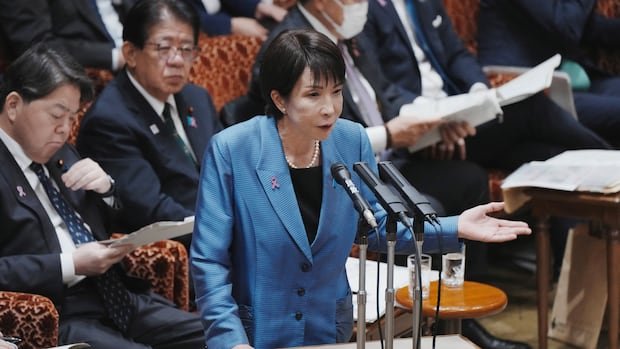

Japan has advised its citizens in China to increase safety measures and steer clear of crowded areas amidst escalating tensions between the two largest economies in Asia over Japanese Prime Minister Sanae Takaichi’s remarks about Taiwan. Takaichi triggered a significant diplomatic conflict by suggesting that a Chinese attack on Taiwan jeopardizing Japan’s existence could lead to a military retaliation.
The dispute has the potential to impact Japan’s economy significantly, with Beijing urging its citizens to refrain from traveling to Japan. Chinese tourists constitute nearly a quarter of all visitors to Japan, according to official data, causing tourism-related stocks in Japan to plummet. More than 10 Chinese airlines, including Air China, China Eastern Airlines, and China Southern Airlines, have offered refunds for flights bound for Japan until December 31, while Sichuan Airlines has postponed its Chengdu-Sapporo route until at least March, as reported by state media.
Efforts to ease the tension were made as a senior Japanese official met with his counterpart in Beijing on Tuesday, although no immediate breakthrough was apparent. Takaichi’s statements in a parliamentary committee on November 7 were more forceful than those of her predecessors, who had expressed concerns about China’s threat to Taiwan without specifying Japan’s potential response.
China considers Taiwan its territory and has not ruled out using force to assert control, a stance rejected by Taiwan’s government. Despite China’s Foreign Ministry urging Takaichi to retract her comments, Japan’s top government spokesperson, Minoru Kihara, indicated that Tokyo was not inclined to do so. Kihara emphasized that the government’s stance remained unchanged and hoped for a peaceful resolution through dialogue on Taiwan-related matters.
The situation has led to negative media coverage in China, prompting the Japanese embassy to caution its citizens to be mindful of local customs and interactions with Chinese nationals. The embassy advised citizens to be vigilant when outdoors, avoid traveling alone, and exercise caution when with children. Trade and access to China’s minerals are also under scrutiny, with Japan emphasizing the risks of overreliance on a country that resorts to economic coercion.
As a result of the diplomatic tensions, the screening of at least two Japanese films in China has been suspended, reflecting a deteriorating sentiment among the Chinese populace. Furthermore, Japan’s dependency on China for critical minerals used in various industries, including electronics and automotive, has raised concerns about supply chain vulnerabilities. The heads of Japan’s three business federations have called for dialogue to address the diplomatic discord.
The strategic location of Taiwan, just over 110 kilometers from Japanese territory, and the crucial sea route it offers for Japan’s trade underscore the significance of the region. Japan, which hosts the largest U.S. military presence overseas, plays a crucial role in the region’s security dynamics. Recent incidents involving Chinese coast guard ships in disputed waters around islands controlled by Japan but claimed by China have added to the tensions.
Despite the complexities of the situation, the U.S. reiterated its commitment to Japan’s defense, including the disputed islands, under the Japan-U.S. security treaty. The Chinese Foreign Ministry criticized the U.S. ambassador’s remarks as a “political show with ulterior motives,” underscoring the ongoing geopolitical challenges in the region.