

In April, Canadian Space Agency (CSA) astronaut Jeremy Hansen achieved a groundbreaking feat during the Artemis II mission, venturing farther from Earth than any other human, alongside three NASA astronauts, on a journey around the moon. This mission marked a significant milestone in NASA’s plan to land humans back on the lunar surface by 2028 with the Artemis IV mission.
Unlike the Apollo program of the 1960s and ’70s, NASA’s Artemis program is a collaborative global initiative with 68 countries, including Canada, as signatories to the Artemis Accords. The objective goes beyond a short visit, aiming for a sustained human presence on the moon, necessitating the development of essential infrastructure such as construction vehicles, transport systems, surveillance equipment, and power sources.
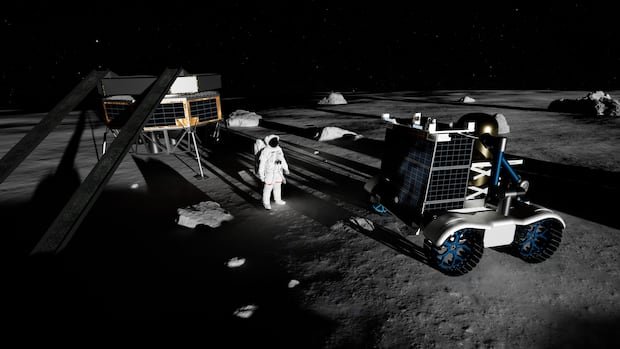
Canada is actively engaging in supporting the mission to return humans to the moon, with Canadian technology already making significant contributions. While the Canadian Space Agency canceled a small lunar rover project in March, plans are underway for a larger lunar utility vehicle scheduled for deployment no earlier than 2033. Three Canadian companies, including MDA Space, Canadensys Aerospace, and Mission Control, are competing to secure the final contract for designing these vehicles.
NASA recently unveiled its Moon Base concept near the lunar south pole, replacing the initial Lunar Gateway space station plans. The construction of Moon Base will occur in three phases, with partnerships established with commercial companies for the provision of lunar rovers and landers. This accelerated timeline may lead to adjustments in the design and development of the lunar utility vehicle, as indicated by Christian Sallaberger, Canadensys’ president and CEO.
Canadensys has a proven track record in lunar exploration, having deployed multiple camera systems on the moon for various international missions. Michele Faragalli, Mission Control’s chief technology officer, highlighted Canada’s longstanding involvement in space exploration, positioning the country as a leading force in space robotics.
Addressing the critical need for power in lunar operations, the Canadian Strategic Missions Corporation (CSMC) is developing a low-enriched uranium nuclear reactor for lunar applications, supported by funding from the Canadian Space Agency. This nuclear power solution is essential for long-term lunar operations and presents potential applications in remote terrestrial communities.
The opportunity for Canadian technology extends to lunar mining, robotics, and other areas, with companies like MDA Space leveraging their expertise in space technologies. With a pivotal role in the evolving lunar exploration landscape, Canada is poised to make substantial contributions following the success of Jeremy Hansen’s mission, emphasizing the importance of seizing the current opportunities for innovation and collaboration.