
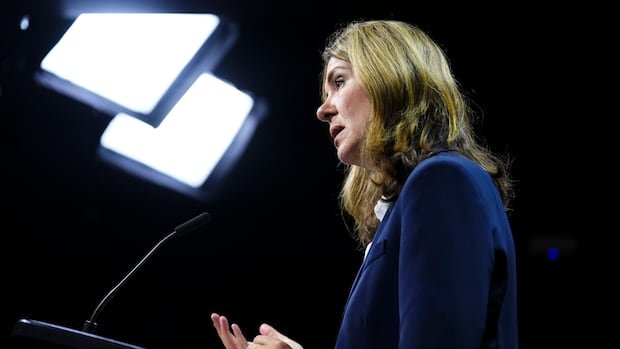

Before the upcoming 112th Grey Cup kicks off at Princess Auto Stadium in Winnipeg, Alberta Premier Danielle Smith anticipates a significant development in the ongoing federal-provincial clash over energy policies. Alberta’s energy policies have been evolving in recent months, with Smith aiming for a breakthrough referred to as a “grand bargain” by the time of the CFL’s championship game on Nov. 16.
Smith expressed her expectation for the federal government to finalize an agreement on a memorandum of understanding by the Grey Cup, allowing the progression towards attracting private investments back to Canada’s natural resource sector. This agreement would involve the removal or revision of what Alberta deems as unfavorable laws and a commitment to advance the approval process for a pipeline to the B.C. coast.
Additionally, Smith is keen on seeing the realization of the Pathways Alliance project, a significant carbon capture and storage initiative near Cold Lake. This project aims to capture carbon dioxide emissions from over 20 oilsands facilities in northern Alberta, transporting them via pipeline to a terminal in the eastern part of the province.
On the federal front, indications suggest the potential scrapping of the proposed oil and gas emissions cap, a key policy of former Prime Minister Justin Trudeau. In return, the federal government is looking towards robust carbon pricing, methane regulations, and increased deployment of carbon capture and storage technologies.
Finance Minister François-Philippe Champagne mentioned that while the emissions cap may no longer be necessary once certain conditions are met, there are several steps remaining in this process. The collaboration between federal and provincial governments on carbon pricing is crucial, with provinces being required to adhere to minimum federal standards.
In a move that adds uncertainty to the situation, Alberta announced the continuation of its freeze on the industrial carbon price at $95 per tonne until 2026. This price misalignment with the federal backstop price, set to increase to $110 per tonne next year and $170 by 2030, has raised discussions on potential adjustments to Alberta’s carbon pricing structure.
Despite differing perspectives on the industrial carbon pricing front, there is hope for collaboration between the federal and Alberta governments. The Pembina Institute emphasized the need for robust industrial carbon pricing and a stable market to achieve the envisioned “grand bargain.”
While the road ahead remains unclear, ongoing dialogues and negotiations between the governments and industry stakeholders aim to pave the way for a balanced approach towards clean and conventional energy development in Canada.