

A company seeking to establish an industrial facility on the Eastern Shore for producing hydrogen and biomass-based fuels has submitted an environmental assessment application to the provincial authorities. This marks the beginning of a 40-day period during which the public can provide feedback on the proposal.
The application outlines the initial phase of the project, which involves setting up a production plant in the vicinity of Isaacs Harbour, N.S. The plant’s operations would involve the daily transportation of 60 truckloads of biomass and the consumption of 586 cubic meters of fresh water per hour. Biomass, such as wood, is utilized as organic material to generate energy.
As per the application, the biomass would be locally procured in compliance with the sustainability criteria of the European Union, while the fresh water supply would be drawn from Meadow Lake and Ocean Lake via pipelines. If environmental approval is granted by the province, construction is slated to commence in 2028, with operations beginning in 2031. The project is anticipated to have a lifespan of at least 50 years before decommissioning.
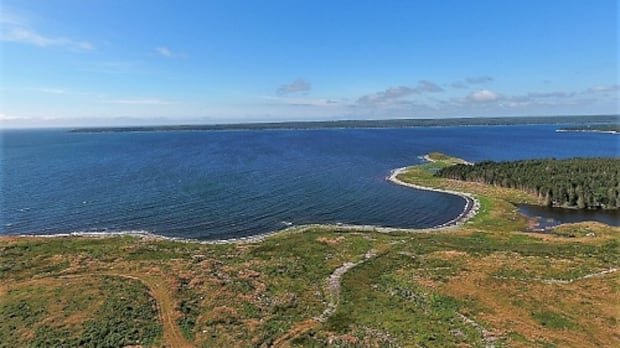
The proposed site is situated in Goldboro, N.S., on land formerly owned by Pieridae Energy, which had previously intended to construct a liquefied natural gas terminal on the site. The property, along with all permits and approvals, was sold to the new developers after Pieridae Energy abandoned its plans.
Initially conceived by the Irish company Simply Blue Group, the project was acquired earlier this year by the European energy corporation Octopus Energy Generation. A local entity named Nova Sustainable Fuels was subsequently established by Octopus to oversee the project.
In its submission to the province, Nova Sustainable Fuels expressed its intention to utilize water, biomass, and wind-generated electricity to produce hydrogen gas, which would then be converted into methanol and sustainable aviation fuel (SAF) as an eco-friendly alternative to traditional jet fuel. The liquid fuels would be transported to distributors and airlines via ships.
Phase 2 of the project is anticipated to involve the establishment of a wind farm and a transmission line to directly supply electricity to the plant, although this aspect is not covered in the ongoing environmental assessment.
The application for Phase 1 estimates an initial investment of $4 billion to $6 billion for the project. The construction phase is expected to create around 1,000 job opportunities, with operational activities requiring a workforce of 60 to 80 employees.
Public feedback on the project can be submitted online or by mail until December 8.