
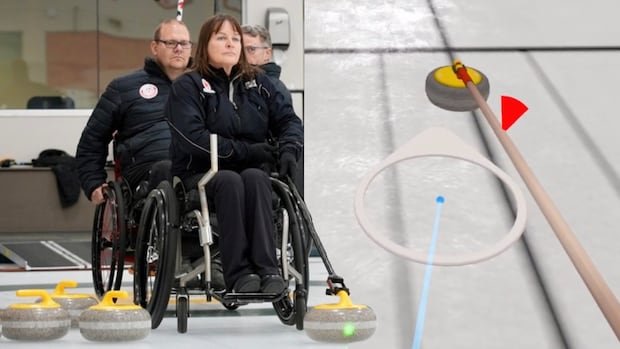

With the 2026 Paralympic Games in Italy approaching in less than nine weeks, the Canadian wheelchair curling team is diligently preparing for the competition. A groundbreaking virtual reality program developed in Alberta aims to enhance their training and performance.
Jennifer Dornstauder, the engineering technical lead of the project created at Red Deer Polytechnic, highlighted the unique aspect of the program designed specifically for seated users. She emphasized that the VR simulation allows athletes to visualize their body movements, providing a novel training experience free from physical constraints.
Wheelchair curling, often referred to as “chess on ice,” requires a high level of strategic planning due to the absence of sweeping. Dana Ferguson, the mixed doubles coach, expressed enthusiasm about utilizing VR technology to elevate the team’s gameplay by enhancing shot accuracy and strategic decision-making.
The VR simulation mirrors the competition arena, offering athletes a familiar environment for mental preparation. Collinda Joseph, a member of Canada’s Paralympic team, emphasized the importance of quickly adapting to the competition setting, noting the VR’s role in providing a spatial visual representation of the arena.
The integration of VR technology in wheelchair curling signifies a progressive approach to training and performance enhancement. Terry Fowler, a wheelchair curler, highlighted the sport’s culture of embracing innovation and continuous improvement, which he believes contributes to Canada’s success in the sport.
The development of the VR software, named “Chess On Ice,” was a collaborative effort involving industry experts and Curling Canada officials. The team behind the project faced challenges in replicating the intricate details of the ice surface and equipment, but their dedication resulted in a functional VR simulator tailored to the needs of para athletes.
Looking ahead, the team aims to enhance the software with features like a heat map, multiplayer mode, and a working scoreboard. The VR technology not only benefits current athletes but also holds potential for introducing newcomers to wheelchair curling, providing a more inclusive and immersive experience for all participants.