
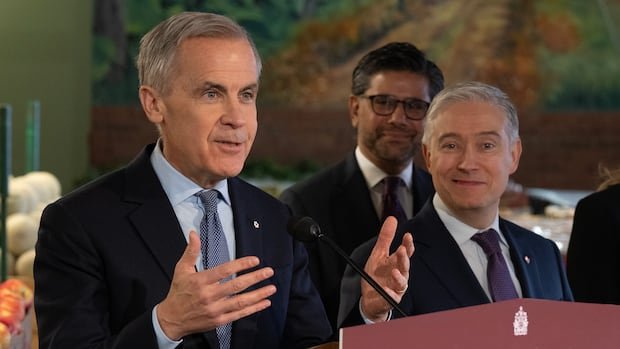

Prime Minister Mark Carney unveiled a series of affordability initiatives on Monday to assist Canadian families grappling with the escalating cost of living. The central aspect of the announcement is the Canada Groceries and Essentials Benefit, aimed at enhancing the GST rebate for families and individuals over the next five years.
Carney, speaking in Nepean, Ont., emphasized the government’s commitment to supporting Canadian families in need by utilizing the GST rebate tailored for low and modest-income households, given that essential items like groceries constitute a significant portion of their expenses.
The Canada Groceries and Essentials Benefit will provide initial one-time boosts for low- and modest-income Canadians eligible for the GST rebate, raising the annual amount from $1,100 to $1,890 for a family of four and from $540 to $950 for an individual in the first year. Subsequently, starting in 2026/27 and continuing for five years, the GST rebate will be increased by 25 percent, resulting in an annual amount of up to $1,400 for a family of four and approximately $700 for an individual.
In response to the surging cost of groceries outpacing inflation, Carney announced the allocation of $500 million from the Strategic Response Fund to aid food suppliers in expanding capacity and enhancing productivity. Additionally, a $150-million Food Security Fund will support small- and medium-sized businesses in expanding greenhouses and abattoirs, thereby fortifying food supply chains.
Furthermore, the government introduced a measure enabling companies to fully write off greenhouses acquired after Nov. 4, 2025, and utilized before 2030. This initiative aims to bolster domestic supply and encourage investments in food production in the medium term.
To alleviate pressure on food banks, Carney disclosed the allocation of $20 million to the Local Food Infrastructure Fund, emphasizing its role in enhancing community food programs to provide nutritious food to families in need.
In tandem with these measures, the government is formulating a National Food Security Strategy to enhance food production, ensure access to affordable, healthy food, and address food insecurity in Canada’s North. Carney highlighted the strategy’s focus on implementing unit price labeling to facilitate comparisons in the face of ‘shrinkflation,’ along with supporting the Competition Bureau’s efforts to monitor and enforce market competition.
Opposition House leader Andrew Scheer criticized the GST rebate as a temporary solution inherited from the previous administration, expressing skepticism about its long-term impact on reducing grocery costs. Despite his reservations, Scheer indicated the Conservatives’ willingness to support temporary relief measures while advocating for fiscal responsibility and budgetary balance.
Scheer outlined conditions for Conservative support, emphasizing the necessity of a standalone bill focused solely on implementing the GST boost. Conservative Leader Pierre Poilievre affirmed the party’s commitment to enabling the passage of the GST top-up in Parliament, signaling cooperation with the government on the initiative.