
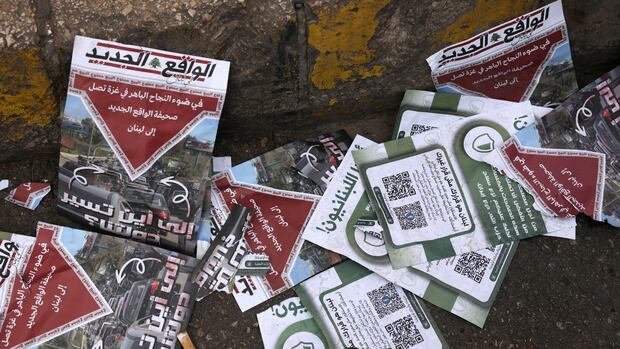

On a Friday in Beirut, two loud explosions reverberated before Israeli leaflets descended upon the city’s residents. The leaflets carried messages reminiscent of Israel’s ongoing offensive in Gaza, urging Lebanese citizens to cooperate with Israeli intelligence services.
“In light of the resounding success in Gaza, the New Reality Newspaper reaches Lebanon,” the leaflets proclaimed. They directly appealed to Lebanese individuals, inviting them to contact Unit 504, an intelligence division of the Israel Defence Forces (IDF), to participate in bringing positive change and safeguarding their country. QR codes on the leaflets linked to Facebook and WhatsApp chats, but cautionary advice from Lebanese authorities and residents warned against scanning the codes due to potential data privacy risks.
Additional statements on the leaflets included messages such as “Lebanon is your decision” and “Your land is yours, don’t let it become ‘free money’ for Iranian Hezbollah’s weapons.”
This event is not the first instance of Israel dropping leaflets over civilian areas. In Gaza, the Israeli military has previously distributed leaflets instructing civilians to evacuate before impending strikes, a practice that has drawn criticism from human rights organizations like Amnesty International for potentially constituting war crimes.
Israel has consistently stated that the purpose of these leaflets is to protect civilians by forewarning them of impending military actions.
Witnessing the leaflets descending, Beirut resident Hala Beydoun described the moment as “very frightening.” She recounted the initial booming sounds followed by pamphlets falling from the sky, causing alarm among the residents.
Described as a form of propaganda by multiple experts, the leaflets dispersed in Beirut on that Friday have raised concerns about potential breaches of international law. Legal expert George Katrougalos, an independent United Nations specialist focusing on democracy and international order, characterized the leaflets as a form of psychological warfare. Katrougalos emphasized that invoking Gaza as a model to be emulated is perceived as a direct threat to the Lebanese population, potentially violating international conventions.
An UN Commission of Inquiry released findings indicating allegations of genocide in the Gaza Strip, a claim vehemently denied by Israel. Amid escalating tensions, world leaders and UN experts, including Katrougalos, have called for de-escalation in Lebanon as the humanitarian situation deteriorates.
Michael Eisenstadt, from the Washington Institute for Near East Policy, attributed the ongoing displacement of Lebanese people to Hezbollah’s alleged violations of a ceasefire agreement with Israel signed in 2024. Despite the ceasefire, Israeli attacks have persisted, with both sides accusing each other of breaching the truce.
Eisenstadt noted that the use of propaganda leaflets is not exclusive to Israel, citing historical precedents of their deployment in various conflicts. He differentiated between legitimate propaganda and actions contravening international law, emphasizing that terrorizing civilian populations is prohibited by international statutes.
Expressing dismay over the situation in Lebanon, Beydoun voiced a desire for peace and normalcy, underscoring the Lebanese community’s aspiration for security and tranquility amidst the ongoing conflict.