
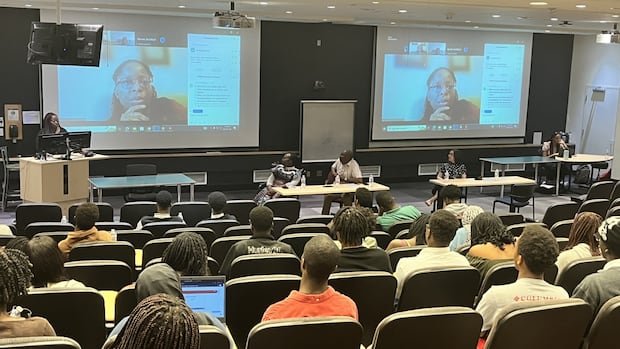

Upon entering the Black Youth Mentorship and Leadership Program, Joel Isu, a nursing student, expressed uncertainty about his future. “I felt a bit lost,” he admitted. “But thanks to the workshops and guidance from the program, I am now on a more promising path.” Isu emphasized the importance of feeling secure in a space specifically tailored for Black youth.

Isu is among numerous Black students in Alberta who have engaged with the program since its inception in 2020. This grassroots initiative links students entering Grades 11 and 12 and undergraduates with mentors, offering leadership workshops and exposure to academic and professional opportunities on university campuses.
High Demand, Limited Capacity
Since its establishment, the program has mentored approximately 300 high school students and 35 undergraduates nationwide. Two years ago, it expanded to Calgary, benefitting an additional 150 students. Program alumni have progressed into medical school, graduate studies, and leadership positions, demonstrating the program’s broad impact.
Despite its expansion, the program faces overwhelming demand. In 2024, 44 students in Alberta were served — 27 in Calgary, 12 in Edmonton, and five online. The following year, over 180 students applied, but due to funding constraints, only 82 were accepted: 52 in Calgary, 19 in Edmonton, and 11 online.
The program aims not only to provide guidance but also to tackle the enduring impacts of generational systemic anti-Black racism, which many Black families have encountered for decades. Dr. Bukola Salami, the program’s founder and a University of Calgary professor, stresses the objective of ensuring that the past experiences of anti-Black racism do not hinder their children and that young individuals possess the tools to excel academically, socially, and professionally.
Racism and its Far-Reaching Effects
The program’s framework mirrors the broader context in which Black Canadians confront discrimination and barriers affecting personal, educational, and economic outcomes. According to Statistics Canada, data spanning 2021 to 2024 reveals that around 51% of racialized Canadians aged 15 and older reported encountering discrimination or unfair treatment in the previous five years, almost