
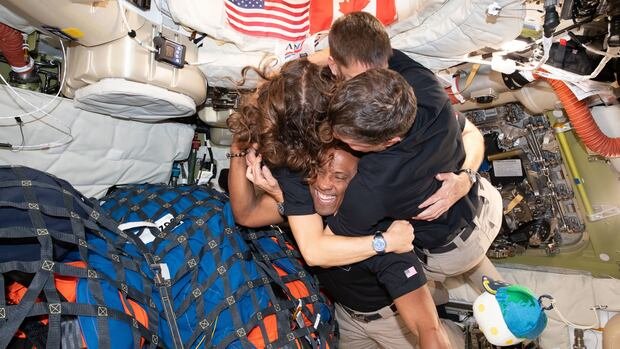

The crew of Artemis II woke up 237,115 kilometers above Earth on Thursday and is set to return home by Friday night. Commander Reid Wiseman, pilot Victor Glover, and mission specialists Jeremy Hansen and Christina Koch started their day listening to Charley Crockett’s country song “Lonesome Drifter” before reviewing re-entry procedures for their upcoming splashdown. NASA officials expressed confidence in the spacecraft’s readiness for re-entry, emphasizing the importance of the heat shield, parachutes, and recovery systems. They acknowledged feeling anxious until the process is completed.
While expressing confidence in the splashdown, NASA associate administrator Amit Kshatriya admitted to feeling anxious about it. The crew’s immediate family members will be present in the mission control room during the event. Lead flight director Jeff Radigan highlighted the checklist of critical tasks that must be executed correctly during re-entry for the crew’s safe return.
During a final video call with members of the U.S. Congress, the crew shared advice for young people inspired by their mission, encouraging them to strive for their best each day. They emphasized the importance of embracing challenges and learning from failures.
NASA reported that crew members Koch and Hansen spent the day securing equipment, stowing cargo, and installing crew seats in preparation for landing. The Orion spacecraft is scheduled to perform a trajectory correction maneuver to fine-tune the crew’s path to Earth before reaching a top speed of 38,405 kilometers per hour. As Orion enters the Earth’s atmosphere, it will jettison the service module and experience a communications blackout before deploying parachutes for a safe landing in the Pacific Ocean off the coast of San Diego, California.
The crew will undergo a carefully orchestrated process to ensure their safety, including assistance from NASA and U.S. military personnel aboard the USS John P. Murtha ship. Once safely on the water, divers will open the hatch and assist the crew onto an inflatable raft for extraction by Navy helicopters. The entire recovery process is expected to take approximately an hour.
Artemis II, which launched on April 1, set a new distance record by surpassing the farthest distance humans have traveled from Earth, reaching 406,771 kilometers beyond the moon. This milestone exceeded the previous record set by Apollo 13 in 1970.