
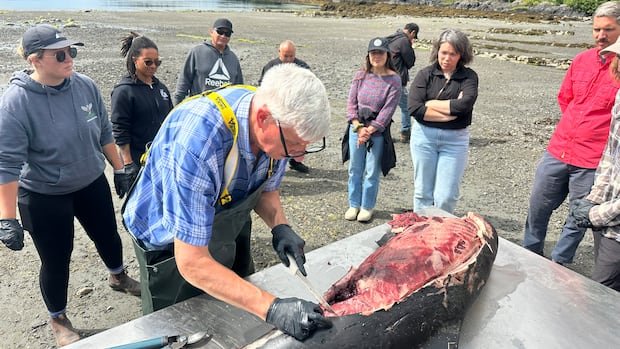

Veterinary pathologist Stephen Raverty, while deeply immersed in his work, often finds himself waist-deep in a challenging task. Imagine him navigating the insides of a humpback whale, surrounded by a mixture of intestines, blubber, and blood. A vivid image from 2011 shows Raverty, covered in purple muck, conducting a necropsy on a humpback whale that washed ashore on San Juan Island near Vancouver Island.
Over the past 25 years, Raverty has conducted approximately 2,500 necropsies on whales and other large marine mammals as part of his role at B.C.’s Ministry of Agriculture and Lands. Describing his work, Raverty mentioned the complexities of maneuvering through different tissues and textures within the carcass, emphasizing the need for stability.
One of his significant findings was confirming a vessel strike as the cause of death for a humpback whale by identifying multiple vertebrae fractures. However, not all moments are as fulfilling, as he once forgot to secure the top of his boots, leading to a pungent experience during a necropsy.
Recently, Raverty has been investigating the death of a humpback whale suspected of being struck by a boat in Howe Sound near Vancouver. This incident was part of a series of humpback whale deaths in the region, including one involving a B.C. Ferries vessel and another off Lasqueti Island.
During his work, Raverty has encountered challenging situations, such as dealing with decomposing carcasses that release unpleasant odors. Despite the difficulties, he remains dedicated to his work, conducting thorough examinations and collaborating with various stakeholders for insights into marine mammal health and ecosystem impacts.
Raverty’s expertise extends beyond physical examinations, as he delves into microscopic analysis and advanced technologies to understand the health and ecological conditions of marine species. His work not only sheds light on individual animal deaths but also contributes to broader population health assessments.
As a respected figure in his field, Raverty’s work highlights the importance of marine mammal conservation and the intricate relationship between human activities and wildlife. His commitment to objective analysis and ecological understanding underscores the profound responsibility of studying and protecting these majestic creatures.