
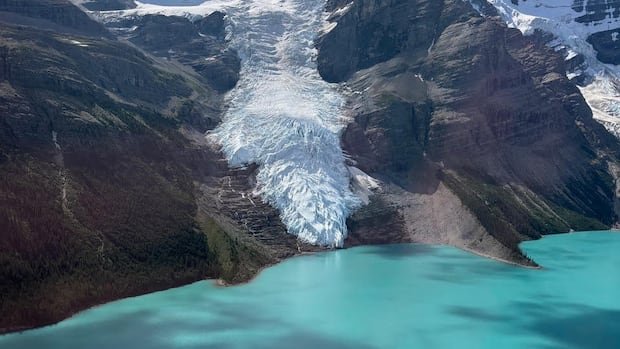

In British Columbia, a notable change is occurring at Mount Robson, where scientists have observed that the Berg Glacier has receded significantly, no longer reaching Berg Lake’s water. Joseph Shea, a geography associate professor at the University of Northern British Columbia, made this discovery during a recent field project on the mountain. The glacier’s retreat marks a symbolic shift, indicating visible signs of glacier transformation in the region.
Situated on the north face of Mount Robson, the Berg Glacier is known for its association with Berg Lake, where ice fragments from its lower edge used to break off and fall into the lake, creating icebergs that floated on the turquoise waters even in the summer months. The Berg Lake area, including the popular 23-kilometer Berg Lake Trail, is a favorite destination for outdoor enthusiasts, with camping spots typically selling out quickly each summer.
Although the glacier’s separation from the lake is not expected to impact the water level significantly, it may reduce the occurrence of icebergs dropping directly into Berg Lake. Despite this change, Mount Robson remains a breathtaking destination, emphasizing the visual representation of climate change.
Researcher Brian Menounos from UNBC has been studying the Berg Glacier as part of his work on glacier melt. Recent findings indicate a significant loss of glacier surface area in Western Canada and Switzerland between 1985 and 2021. Climate change has also severely impacted the Berg Lake Trail, leading to substantial damage during a record-breaking heatwave in 2021, prompting evacuations and subsequent restoration efforts.
Efforts are underway to enhance monitoring and response systems, with B.C. Parks collaborating on setting up real-time weather stations in the region. These stations will collect crucial data on weather patterns, aiding in park management decisions, wildfire forecasting, and avalanche monitoring. The availability of real-time data is expected by late 2026, providing valuable insights for Mount Robson Provincial Park staff to ensure visitor safety and park operations.