
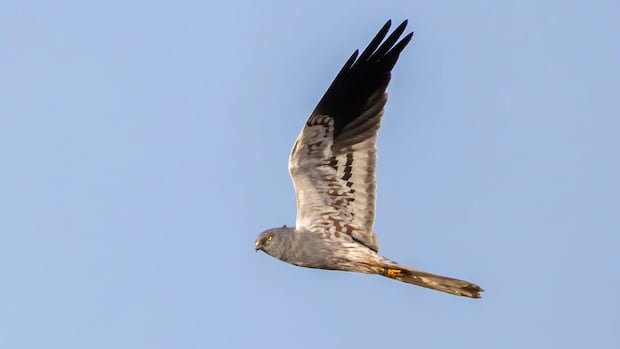

Conservationists in the United Kingdom have been diligently working to preserve a rare bird species known as Montagu’s harrier from vanishing completely. Recent progress in safeguarding the British population of these birds can be significantly credited to the exceptional mating abilities of a single male bird, described as “absolutely prolific” by conservationist Mark Thomas.
This remarkable 10-year-old male, named AU after the chemical symbol for gold, has fathered a total of 16 offspring throughout his life, with 10 of them born in the past two years alone. According to Thomas, who serves as the species lead for the Royal Society for the Protection of Birds (RSPB), AU’s significant contribution has been crucial in sustaining the species in the U.K.
Montagu’s harriers are migratory birds of prey that winter in Africa and parts of Asia, returning to Europe each spring for breeding. While their global population is declining, they are currently classified as a species of least concern on the International Union for Conservation of Nature’s Red List. In the U.K., the RSPB reports a rapid decline in these already rare birds, with numbers reaching zero breeding pairs in the 1970s, then increasing to 13 pairs in the mid-2000s, followed by another drop to zero breeding pairs between 2000 and 2003.
The success of preserving the species in the U.K. is largely attributed to AU, who successfully raised four chicks in 2025 and returned the following year for more mating displays. This year, three female harriers vied for AU’s attention, resulting in two females nesting with him. Between his two mates, AU fathered a total of six chicks, consisting of four females and two males.
Conservationists are optimistic that AU’s sons will eventually return to the U.K. to breed, with two male offspring from 2025 already spotted in the country, though not yet of breeding age. The six new hatchlings are split between two nests located approximately one kilometer apart on a British farm, kept secret to protect the chicks from predators and other dangers.
To safeguard the Montagu’s harriers, which prefer nesting in marshes and river plains or among farmland crops, the RSPB collaborates with farmers to protect the nests. For the first time, satellite trackers have been attached to two juvenile harriers, allowing researchers to monitor their movements during migration and potential return for breeding.
The data collected from these trackers will provide valuable insights for conservation efforts, offering new possibilities to track and protect the Montagu’s harrier population in the U.K.