
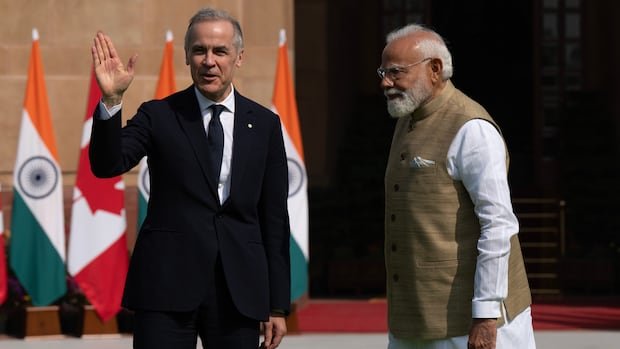

Prime Minister Mark Carney and his Indian counterpart have revealed a fresh collaborative effort, including numerous multimillion-dollar agreements and a commitment to finalize a free trade agreement by the end of this year, aiming to mend years of strained bilateral relations tainted by accusations of Indian foreign meddling.
Following a private meeting with Indian Prime Minister Narendra Modi at Hyderabad House in Delhi, Carney emphasized Canada’s dedication to expanding trade diversification. Both nations have set a target to double their bilateral trade to approximately $70 billion annually by 2030, in a bid to lessen Canada’s reliance on the U.S.
Carney portrayed this new direction as not merely a revival but a bold reimagining of the potential collaboration between the two Commonwealth nations in a turbulent era marked by uncertainty. At the core of this enhanced relationship will be a Comprehensive Economic Partnership Agreement, or a free trade deal, anticipated to be signed by December. This agreement is expected to provide Canadian exports relief from high Indian tariffs on certain goods.
During a joint statement with Modi, Carney articulated, “This is not just a renewal of a relationship but an expansion of a valued partnership with new ambition, focus, and foresight — a partnership between two confident countries navigating a path for the future.”
Modi, known for being media-shy and rarely participating in press conferences alone over the past 15 years, refrained from addressing questions on the substantial foreign policy shift for both nations. Modi lauded Carney’s leadership at two central banks and credited him for the improving ties between the two countries.
The resurgence of diplomatic dialogue under Carney’s leadership has fostered a more amicable relationship, culminating in Modi’s potential visit to Canada in the near future.
Described as the “beginning of a prosperous, new relationship,” there has been increased engagement between the Canadian and Indian governments this year compared to the past two decades. This elevated engagement led to the signing of five memorandums of understanding between Canada and India, spanning sectors such as energy, technology, defense, and culture, with a total worth of $5.5 billion.
Among these agreements, a significant $2.6 billion deal was struck between the Government of India and Cameco, a Saskatoon-based company, to supply nearly 22 million pounds of uranium for nuclear energy generation from 2027 to 2035. Additionally, there are agreements for the expansion of pharmaceutical manufacturing, AI centers, coal trade, and agricultural partnerships between the two countries.
As both nations aim to tackle security challenges and transnational organized crime networks, efforts will be intensified to enhance bilateral cooperation on security and law enforcement, focusing on combating illegal drug trafficking and transnational repression.
The Canadian government acknowledges the need for diplomatic engagement with India despite past allegations of interference, emphasizing the importance of dialogue to make progress. Though questions persist about past interference activities, both countries are committed to advancing mutual cooperation and fostering a new era of collaboration.
[End of rewritten article]