
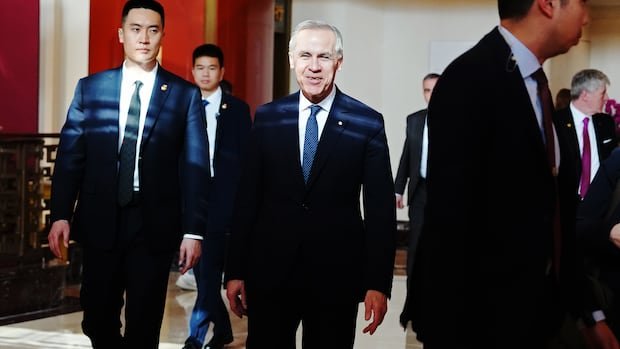

On his initial day of discussions in Beijing, Prime Minister Mark Carney engaged in talks with the Chinese government to enhance cooperation on both clean and traditional energy sources, marking a positive turn in relations following years of challenges between the two nations. While progress has been made with the initiation of ministerial-level dialogues, an existing tariff dispute remains unresolved.
Although an agreement was reached on energy collaboration, China did not commit to increasing its purchases of Canadian petroleum and liquefied natural gas (LNG) as desired. Energy and Natural Resources Minister Tim Hodgson emphasized China’s interest in acquiring more Canadian products during the signing of a memorandum of understanding, which focuses on oil and gas resource development, LNG, liquified petroleum gas, and emission reduction discussions.
To strengthen ties and increase non-U.S. exports over the next decade, Carney aims to overcome past diplomatic tensions with Beijing. The prime minister anticipates a meeting with China’s President Xi Jinping on Friday to further advance their relations. Despite ongoing efforts, there is no immediate resolution in sight regarding Beijing’s retaliatory tariffs on Canada’s agriculture sector, including canola.
In a significant move towards economic cooperation, Canada and China signed a “road map” to boost trade and address past challenges. The agreement also includes plans to elevate Canadian pet food exports to China, enhance tourism, and reinforce previous commitments such as combating crime.
Industry Minister Mélanie Joly expressed optimism about the newly formed partnership with China, highlighting the efforts to address longstanding issues and establish a strategic alliance between the two countries. Carney emphasized the recent advancements as essential for positioning Canada and China in the evolving global landscape for mutual stability, security, sustainability, and prosperity.
While discussions with Chinese officials indicated a willingness to remove obstacles and strengthen communication and trust, the pressure remains on Carney to address Beijing’s retaliatory tariffs on Canadian agricultural products. Despite the presence of Saskatchewan Premier Scott Moe during the talks in Beijing, negotiations are ongoing to resolve the tariff issues and enhance bilateral trade relations.
In preparation for the visit, Canadian officials anticipate progress in resolving trade disputes, although a complete elimination of China’s tariffs may not be immediately achievable. Carney’s visit to China underscores his commitment to navigating past diplomatic challenges and expanding trade opportunities, aligning with his goal of significantly increasing non-U.S. exports in the coming years.