
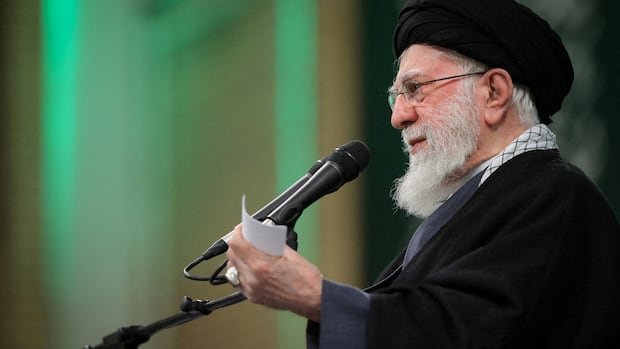

Iran’s top leader issued a stern warning on Sunday, cautioning that any potential assault by the United States could trigger a “regional conflict” in the Middle East. The tension has been escalating as President Donald Trump has hinted at a military strike against Iran due to its handling of recent nationwide protests.
The statement from Ayatollah Ali Khamenei, aged 86, represents his most explicit threat yet. This comes as the USS Abraham Lincoln aircraft carrier and accompanying American warships are stationed in the Arabian Sea, a move made by Trump following Tehran’s violent suppression of the recent protests.
The intentions of Trump regarding the use of force remain uncertain. While he has suggested Iran’s interest in negotiations and highlighted concerns about Tehran’s nuclear program, Khamenei labeled the nationwide protests as “a coup,” indicating a firm stance by the government. Reports suggest tens of thousands of individuals have been detained since the demonstrations began, primarily driven by economic grievances within Iran.
In a show of strength, Iran had organized a live-fire military exercise in the key Strait of Hormuz over Sunday and Monday, a critical chokepoint for global oil trade. The U.S. military’s Central Command had cautioned against any threats to American vessels or disruption of commercial traffic during the drill.
Addressing a gathering in Tehran to commemorate the country’s 1979 Islamic Revolution, Khamenei accused the U.S. of coveting Iran’s resources and warned of dire consequences in case of a conflict. He emphasized Iran’s defensive posture but underscored its readiness to retaliate against any hostile actions.
Khamenei toughened his stance on the protests, characterizing them as a subversive attempt to destabilize Iran. While acknowledging some legitimate economic concerns among the protesters, he condemned the violence and targeted attacks on key institutions. The crackdown has reportedly led to a significant number of arrests, with conflicting figures on casualties and detainees.
Additionally, Iran’s parliament speaker declared all European Union military forces as terrorist groups in response to the EU’s classification of Iran’s Revolutionary Guard as a terror organization. This reciprocal move, largely symbolic, follows a similar U.S. designation in 2019.
As tensions persist, Trump has established clear red lines for potential military action, emphasizing the protection of peaceful protesters and detainees. He has also raised concerns about Iran’s nuclear program, suggesting the need for a satisfactory agreement to prevent nuclear proliferation in the region.
The situation remains fluid, with Trump refraining from divulging any decisions on potential actions against Iran. Emphasizing the importance of negotiations, he mentioned ongoing discussions with Iran while underscoring the necessity of preventing the country from acquiring nuclear weapons.