
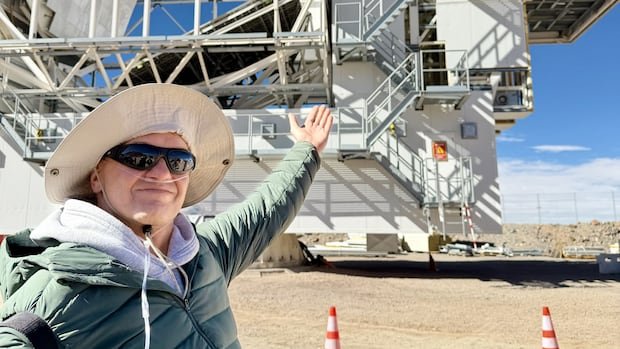

A groundbreaking telescope project involving Canadian researchers aims to unravel profound cosmic mysteries from a remote peak in Chile’s Atacama Desert. Positioned at an elevation exceeding 5,600 meters, the Fred Young Submillimeter Telescope offers an unobstructed view of the universe’s wonders due to its high altitude and dry environment.
The telescope, a collaboration between Cornell University’s CCAT Observatory in New York and institutions from Chile, Germany, and Canada, is poised to illuminate the formation and movement of stars and galaxies, as well as shed light on dark energy and dark matter. It will also provide insights into the universe’s origins by looking back in time.
Canadian astronomer Mike Fich, leading the Canadian team, highlighted the telescope’s exceptional clarity comparable to space-based observations but at a fraction of the cost. The instrument’s wide field of view enables comprehensive sky mapping within minutes, a feat previously thought achievable only in space.
The project, spearheaded by Cornell University, involves researchers from various Canadian institutions such as the University of Toronto, the University of Alberta, McGill University, and McMaster University. The telescope, costing around $40 million, is equipped with cutting-edge technology, including quantum sensor cameras developed by a Canadian research team. These cameras operate at freezing temperatures close to absolute zero, enabling the detection of submillimeter wavelengths invisible to the naked eye and traditional instruments.
The telescope’s capacity to observe extremely cold gas clouds, crucial for star formation, is pivotal for studying the Milky Way and distant galaxies’ evolution. By peering into the past through light emitted by distant galaxies, the telescope will unravel ancient cosmic processes, offering a glimpse into the universe’s early stages.
The project’s German partners are establishing specialized data processing centers to handle the massive data output, necessitating substantial computational capabilities. The challenging construction process, involving transporting and assembling components at the remote site, required meticulous planning and logistical coordination.
Despite the complex logistics, the project is progressing steadily, with Chapman’s team preparing to install the quantum sensor cameras this summer. The forthcoming data analysis phase will be critical for deriving meaningful scientific insights from the telescope’s observations, with results expected to be publicly shared in due course.