
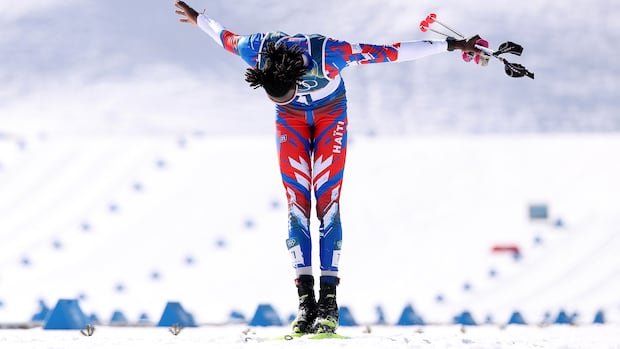

Stevenson Savart crossed the finish line at the Tesero cross-country skiing stadium in Val di Fiemme, securing the 64th spot to the thunderous applause of the crowd. The first athlete to represent Haiti in cross-country skiing at the Olympics, Savart, who also carried his country’s flag, acknowledged the cheering spectators by waving his hands and taking a bow.
Raised in France by a French couple after being adopted, the 25-year-old Savart initiated his skiing journey in France but aspired to showcase Haiti’s presence in elite winter sports. With Haiti lacking snow, the question arises about how such nations, devoid of snowy conditions, find their way to the prestigious Milano-Cortina Olympics.
The increasing involvement of nations not conventionally associated with winter sports, such as Nigeria, Kenya, Jamaica, and various tropical and small island nations, has sparked interest at the Games. Among the 33 countries with only a couple of athletes competing, eight African countries have 14 athletes participating, a rise from the previous edition in Beijing.
The emergence of countries like Eritrea in the winter sports domain, exemplified by Canadian-born alpine skier Shannon-Ogbnai Abeda, who represents Eritrea, underscores a broader trend. Abeda, in his third Olympics and likely his final appearance, aimed not only for a podium finish but also aimed to establish Eritrea’s presence in winter sports.
The growing influence of the diaspora plays a pivotal role in expanding the footprint of countries in winter sports, with immigrants assimilating into the sports culture of their adopted countries. Athletes like Abeda, who grew up skiing in the Rocky Mountains, reflect this trend, paving the way for others in their community to break norms and explore new sporting avenues.
Representing Venezuela in cross-country skiing, Canadian-born Nicolas Claveau-Laviolette exemplifies the common practice in sports where athletes, rooted in one place, represent another nation on the global stage, fostering international connections while staying connected to their heritage and background.
Maaria Shaikh, a 16-year-old born in Mississauga, Ont., who plays for the Pakistan national women’s ice hockey team, challenges stereotypes and aims to alter perceptions about Pakistanis in sports. Her dual mission involves excelling in ice hockey while debunking misconceptions about Pakistan’s sporting capabilities.
While countries like Pakistan continue their quest for Winter Games medals, their presence and determined efforts contribute to the gradual development of winter sports programs. Trinidad and Tobago and Jamaica, with foreign-born athletes like bobsleigh pilot Axel Brown and the iconic Jamaican bobsled team, showcase the diversity and inclusivity of the Winter Olympics.
Kelli Delka, Puerto Rico’s lone Olympian in Milano Cortina, epitomizes the dedication and perseverance required to compete on the world stage as an athlete from a small nation. Delka’s journey underscores Puerto Rico’s commitment to enhancing its winter sports program and showcasing its talent on the international platform.
The participation of athletes like Savart, Abeda, Shaikh, and Delka not only symbolizes personal achievements but also signifies a broader narrative of inclusivity, diversity, and the evolving landscape of winter sports on a global scale.