
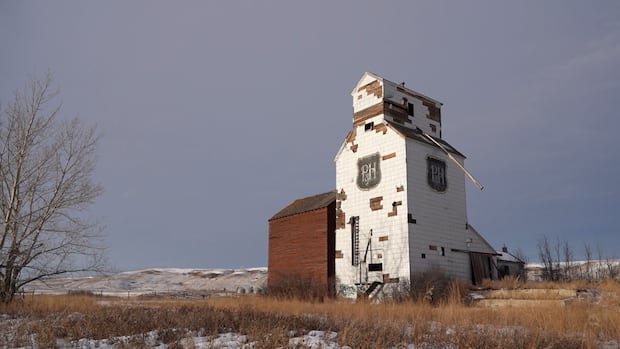

Wooden grain elevators, once prominent on the prairie landscape, have been disappearing in recent decades, with many succumbing to fires or being demolished due to safety concerns. In Sharples, Alta., located approximately 30 kilometers west of Drumheller, one such elevator is facing its demise.
Constructed in the 1920s by Parrish & Heimbecker following the addition of a spur line by the Canadian Pacific Railway in 1923, the Sharples Elevator has remained unused since 1982 when CPR discontinued the railway line and removed the tracks. Now owned by Alberta Trail Net, a nonprofit organization aiming to develop a recreational trail along the former rail line, the deteriorating elevator poses a significant liability.
Marvin Bjornstad, a board member of Alberta Trail Net, expressed that the elevator’s condition is worsening, necessitating action. With an estimated repair cost of around $360,000, Bjornstad mentioned that demolition is the only viable option, despite acknowledging that local residents and history enthusiasts would lament its loss.
Demolition contractors are being contacted, and the dismantling is expected to take place in the upcoming spring. This decision has disappointed many grain elevator enthusiasts, including Dan Overes, who has visited and documented over 100 such structures across the Prairies. Sharples stands out as a rare example of a traditional wooden elevator that includes a barn, reflecting a bygone era when farming communities gathered to deliver their harvest.
Furthermore, another historic grain elevator in Three Hills was recently demolished, adding to the dwindling number of these structures. However, there have been successful preservation efforts, such as the restoration of the Dorothy Grain Elevator located southeast of Drumheller, which suffered damage in a 2015 windstorm.
Despite the challenges in physical preservation, technology offers alternative solutions. Peter Dawson, an archaeology professor at the University of Calgary, is working on creating digital twins of endangered heritage sites, including grain elevators in Alberta and Saskatchewan, using advanced technology like drones and terrestrial LiDAR. These digital renderings are drawing international interest, underscoring the importance of preserving these iconic structures for future generations.
While not all grain elevators can be saved, Dawson hopes that his digital models will not be the sole remnants of these Prairie landmarks, emphasizing the significance of maintaining these structures for posterity.