
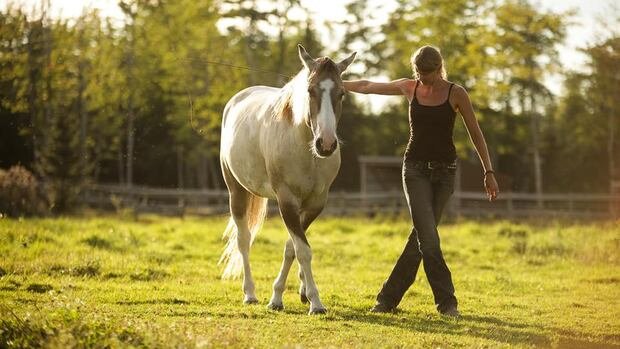

A horse owner residing near Stewiacke, Nova Scotia, expressed concerns over the current hay shortage in the province, highlighting the financial strain it is causing her. Kaila Watters, like many other farmers and horse owners in the area, typically procures hay locally. However, due to the ongoing drought conditions, she has resorted to sourcing hay from Alberta and Quebec, leading to increased costs for transportation to feed her extensive animal collection comprising over 30 horses, 12 alpacas, and two sheep.
The scarcity of hay has prompted some individuals to contemplate selling their animals for financial survival. While Watters has not reached that point yet, the mere thought adds significant stress to her situation. She emphasized the constant worry about having an adequate hay supply to sustain her animals.
The escalating prices of hay are evident in Watters’ expenses, with compressed hay bales now costing between $11.50 and $12.70 each, compared to the previous local prices of $6 to $8 for high-quality small hay squares. These costs do not even include the additional expenses for fuel and off-loading fees, further burdening her budget.
Running Meadow Brook Stables, Watters typically requires over 350 large hay squares, more than 50 round bales, and 500 small hay squares to meet the feeding needs of her animals, resulting in a substantial financial outlay. The early onset of feeding hay due to poor pasture growth, a consequence of the drought, has accelerated the consumption rate, intensifying the demand for hay in the region.
Another farmer, Crystal Joyce Manning, faced a different dilemma amid the challenging hay prices. Struggling with her business since fall, Manning made the difficult decision to downsize her livestock before winter to prevent facing difficulties in feeding the animals. Despite her emotional attachment to the animals, she sold numerous horses and had to euthanize one due to old age, reducing her stable from 40 saddle horses to 27 and her beef cattle from 100 to around 75.
Manning expressed the emotional toll of parting with her animals, noting the challenge of having just enough feed to sustain her reduced livestock. She regretfully declined requests from friends and neighbors for hay, emphasizing the necessity to prioritize her own animals’ needs amidst the hay scarcity.
Reflecting on the supply side, Courtney Copeland highlighted the impact of the drought on hay production. In a typical year, Copeland would harvest two cuts of hay and three of silage to cater to her regular clients. However, this year’s yield was severely affected, with no second cut of hay due to poor regrowth. The heightened demand for hay led Copeland to exhaust her limited supply during the summer, receiving desperate pleas from community members seeking hay for their animals.
To assist friends and clients in need, Copeland leveraged her industry contacts to secure surplus hay from a New Brunswick grower. Despite this effort, the available 672 square bales are insufficient to meet the widespread demand for hay across the province.
Looking ahead, Watters emphasized the need for a more robust hay network akin to those in drought-prone regions like Texas, where farmers have established support systems to ensure hay availability during crises. She underscored the importance of logistical planning and infrastructure enhancements to better prepare farmers for extreme weather events such as droughts and floods in the future.