
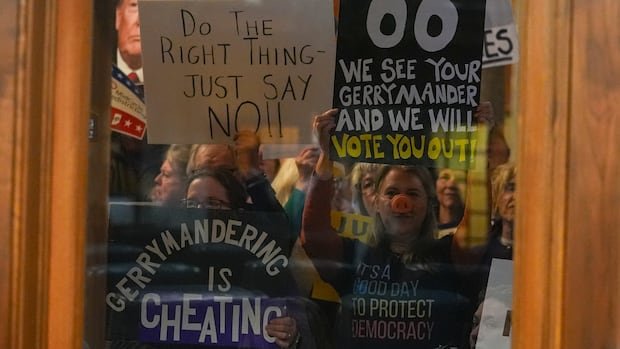

Indiana’s Republican-controlled Senate rejected a newly proposed congressional map on Thursday that would have favored their party, despite pressure from U.S. President Donald Trump. The vote against the redistricting plan was clear, with more Republicans opposing it than supporting it, indicating the limitations of Trump’s influence in the traditionally conservative state. Cheers and expressions of gratitude filled the chamber when the proposal failed by a margin of 31-19.
State Senator Michael Bohacek, a Republican, criticized the proposal, labeling it as “bad policy” that overly emphasizes transactional aspects in the legislative process. Bohacek, who publicly announced his intention to vote against the measure in a Facebook post, also condemned Trump’s derogatory remarks aimed at Minnesota Governor Tim Walz, especially given Bohacek’s personal connection as a parent of a child with Down syndrome.
Bohacek and fellow Republican Ed Clere, who opposed the bill in the House, faced bomb threats necessitating police intervention, attributing these threats to Trump’s pressure tactics and a competitive mindset within the party. Indiana state police disclosed that several other individuals received threats, without delving into specifics due to an ongoing investigation.
The rejection of the redistricting plan has stirred both safety concerns and potential political consequences, as half of Indiana’s senators face re-election next year. Organizations like Turning Point Action, led by Charlie Kirk, have pledged support for campaigns against Republicans who defied the proposal. Former U.S. Congressman Mike Braun vowed to collaborate with the President to challenge those he believes do not represent the best interests of Indiana residents, referred to as Hoosiers.
Despite the setback, Trump downplayed his involvement in the redistricting efforts, remarking that he was not heavily invested in the process. Redistricting is typically conducted to reflect population changes following the national census every decade. Trump’s push for redrawing congressional maps aimed to help the Republican Party maintain its narrow majority in the House of Representatives, with states like Texas, Missouri, Ohio, and North Carolina complying, potentially affecting several Democratic-held seats.
The proposed Indiana map sought to secure all nine congressional seats for Republicans, eliminating two Democrat-held districts by dividing Indianapolis among multiple rural districts and reshaping existing safe Democratic districts. The rejection of the map drew praise from former Indiana Governor Mitch Daniels, who commended the senators for their principled stand against the proposal and criticized the pressure exerted by Trump and associated groups.
Democratic lawmakers in Indiana voiced their opposition to redistricting, emphasizing the importance of fair competition in elections. Republican Senator Michael Young highlighted the significance of the upcoming elections, with Democrats nearing a potential shift in control of the U.S. House in 2026. Vice-President JD Vance and Trump engaged in multiple efforts to garner support for the redistricting plan, with various groups endorsing the initiative, including the Heritage Foundation and Turning Point USA.