
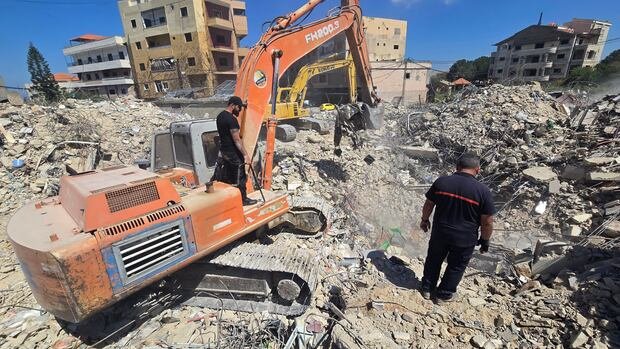

Israeli airstrikes resulted in the deaths of five individuals, including a journalist, in southern Lebanon on Wednesday, as reported by Lebanon’s state news agency. Hezbollah responded by launching an attack drone at Israeli forces in the south, escalating tensions and challenging the existing ceasefire between the two nations.
According to Lebanon’s state-run National News Agency (NNA), an Israeli strike targeted a car in at-Tiri, a village in southern Lebanon, claiming the lives of two occupants. Additionally, two more people were killed in an Israeli airstrike in the town of Yohmor, as reported by NNA and Lebanon’s Health Ministry.
The airstrikes near at-Tiri also injured a journalist and trapped another individual under debris, with rescuers initially impeded by ongoing Israeli military activity, stated Lebanon’s health ministry, a senior military official, and press advocates. Tragically, Amal Khalil’s body was discovered under the rubble later.
In a separate incident in Jabbour, in the West Bekaa region, one person was killed, and two others were injured in an attack, as per the state news agency. Israel’s military, however, refuted any involvement in that particular area.
On the brink of discussions between Lebanese and Israeli ambassadors in Washington, Lebanese President Joseph Aoun expressed the intention to extend the current 10-day ceasefire mediated by the U.S., set to end on Sunday. The ceasefire came about following hostilities reignited on March 2 when Hezbollah engaged in conflict in solidarity with Iran.
While the ceasefire in Lebanon evolved independently of U.S.-Iran peace efforts, Iran advocated for Lebanon’s inclusion in broader truce discussions. Hezbollah retaliated on Wednesday by launching a drone at an Israeli post in Bayada village in southern Lebanon, citing Israeli breaches during the ceasefire.
Israel’s military countered, accusing Hezbollah of ceasefire violations and intercepting a hostile aircraft aimed at Israeli soldiers in southern Lebanon. The aircraft was thwarted by Israel’s air force and did not breach Israeli airspace.
French President Emmanuel Macron confirmed the death of one of three French soldiers wounded in an attack on peacekeepers in Lebanon last week. Another soldier had previously succumbed to injuries from the attack, attributed to Hezbollah.
President Aoun outlined the objectives of future talks, emphasizing a cessation of Israeli assaults, Israeli troop withdrawal from Lebanon, release of Lebanese detainees in Israel, deployment of Lebanese troops along the border, and initiation of reconstruction efforts.
Lebanon advocates for extending the ceasefire as a prerequisite for advancing talks towards broader negotiations, according to a Lebanese official. Israeli Foreign Minister Gideon Sa’ar urged Lebanon to collaborate in disarming Hezbollah, citing minor border disputes as solvable issues hindering peace.
Highlighting Hezbollah as the main obstacle to peace, Sa’ar emphasized Lebanon’s potential for sovereignty, independence, and freedom from Iranian influence once Hezbollah is neutralized. Israel’s military has established a buffer zone extending approximately 10 kilometers into southern Lebanon to mitigate security threats.
The death toll in Lebanon since Israel’s retaliatory offensive to Hezbollah’s March 2 attack exceeds 2,400 individuals, as reported by Lebanese authorities. Hezbollah, attributing the ceasefire to Iranian pressure, criticized Beirut for engaging in talks with Israel, underscoring internal divisions over Hezbollah’s disarmament.
U.S. Secretary of State Marco Rubio is slated to attend upcoming talks, with Lebanon represented by its ambassador to Washington, Nada Moawad, and Israel by its ambassador, Yechiel Leiter. President Trump, upon announcing the ceasefire, directed key officials to collaborate with both nations to secure lasting peace.
Formally at war since Israel’s establishment in 1948, Lebanon and Israel are navigating complex negotiations amid historical tensions. Parliament Speaker Nabih Berri of Lebanon opposes direct negotiations with Israel, advocating for indirect diplomatic channels instead.