
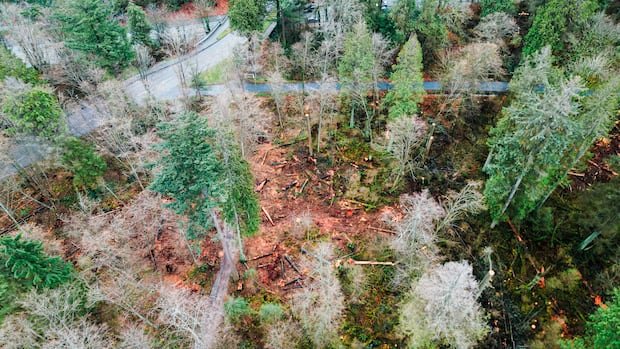

A group in Vancouver, striving to preserve numerous trees in Stanley Park from being chopped down, faced another setback in a recent legal dispute. The City of Vancouver was found to have not adhered to its own regulations while hiring a company to clear extensive sections of the city’s urban forest.
The B.C. Supreme Court’s ruling this week upheld the city and the Vancouver Park Board’s decision to proceed with the final stages of a project to remove trees in Stanley Park. Initiated in 2023 due to concerns regarding trees affected by a hemlock looper moth infestation, the park board estimated that around 160,000 trees, constituting one-third of the park’s total trees, were either dead or dying due to the infestation that lasted four years.
Despite objections from the Save Stanley Park Preservation Society since the project’s inception, claiming the plan lacked scientific backing and was rushed without adequate consultation, Justice Jasvinder Basran ruled against the society’s arguments on Dec. 17.
Basran stated that there was no concrete evidence that the park board blindly accepted staff recommendations, emphasizing that the board did not prejudge decisions leading to the approval of three resolutions related to the project. However, Basran did point out that the city did not obtain the necessary park board approval to engage in a $1.9-million contract with B.A. Blackwell & Associates Ltd., a forestry consulting firm, for tree removal.
The hemlock looper moth, native to B.C., experiences periodic outbreaks every 11 to 20 years, lasting approximately three years, as reported by Natural Resources Canada. The moth’s larvae are known for voraciously consuming foliage, potentially killing a tree within one season, causing significant damage during an outbreak.
The infestation in Stanley Park from 2019 to 2022 affected various tree species, exacerbated by severe drought conditions in 2022 and 2023. B.A. Blackwell & Associates, in a 2020 assessment report, highlighted an increased wildfire risk in the park due to accumulated fallen branches and dead trees, estimating up to 160,000 trees might require removal. To date, approximately 11,000 dead and dying trees have been eliminated across three project phases.
The city has replanted about 54,000 seedlings of native tree species in the park since 2024, including western red cedar, Douglas fir, grand fir, red alder, Sitka spruce, and Pacific yew. Over $18 million has been allocated for tree removal, replanting, and looper moth mitigation efforts since 2023, with the final phase of work expected to cost over $3 million and conclude in 2027.