
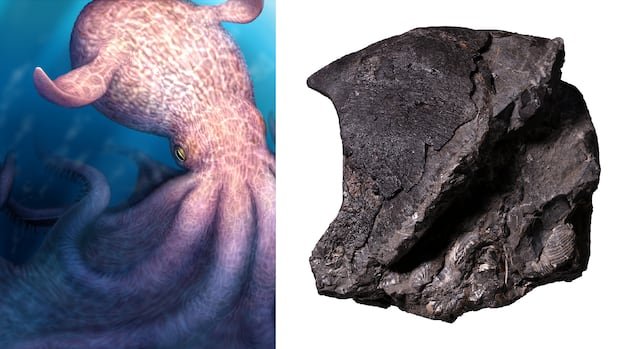

Monstrous octopuses, comparable in size to modern whales, roamed the oceans during the Age of Dinosaurs, capturing prey with their massive tentacles and devouring them with robust jaws, according to findings from fossils discovered in British Columbia and Japan. These sea creatures, reminiscent of legendary tentacled monsters like the Kraken, reached lengths of up to 19 meters, equivalent to the size of a sei whale, the third largest whale species alive today.
The study, recently published in the journal Science, unveils two identified species, with one, Nanaimotethis haggarti, potentially ranking as one of the largest invertebrates in Earth’s history, as per Yasuhiro Iba, a professor at the University of Hokkaido and the study’s senior author. In contrast, the modern giant or colossal squid, the current record holder, typically reaches lengths of about 12 meters.
Describing Nanaimotethis as “terrifyingly large,” Cameron Tsujita, a paleontology professor at Western University in London, Ontario, remarked on the impressive size of these ancient octopuses. The study also reveals that these colossal octopuses possessed the ability to consume heavily protected prey, indicated by the wear patterns on their fossilized beaks, as reported by Iba and his research partners in Japan and Germany.
In a period dominated by large marine reptiles such as mosasaurs and elasmosaurus, the presence of these gigantic octopuses added further concerns for smaller sea creatures like fish, sea turtles, and ammonites. Iba highlighted that the study showcases the role of giant invertebrates, particularly octopuses, as part of the top predator community during that era.
An intriguing observation from the study pointed out by Tsujita was the asymmetrical wear on the octopuses’ jaws, suggesting a potential preference for capturing prey on one side, hinting at a level of “handedness” associated with intelligence, a trait modern octopuses are known for.
The fossils, extracted from rock formations in British Columbia and Hokkaido, Japan, were primarily beaks or jaws, as soft-bodied octopuses are rarely preserved through fossilization. The advanced technique of “digital fossil mining” enabled researchers to reconstruct detailed 3D models from layered rock samples, confirming that the Nanaimotethis species were finned octopuses rather than vampire squids, residing primarily in deep ocean habitats.
Living between 100 million to 72 million years ago, these octopuses represent the oldest known specimens, predating any other documented octopus fossils by at least five million years. The distinct features of Nanaimotethis compared to modern octopuses raise intriguing questions about the evolution and origins of these remarkable sea creatures.