
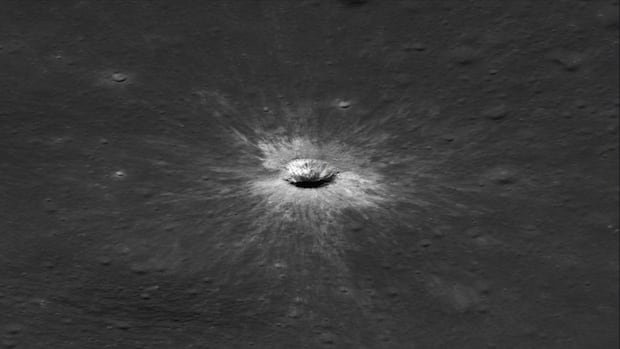

A massive crater on the moon, larger than the Roman Colosseum, has been uncovered by scientists, resulting from a powerful impact that occurred two years ago and went unnoticed at first. Measuring 222 meters across and up to 43 meters deep, this crater is the most significant impact crater in the solar system created in recent times.
Researchers have estimated that such a significant event happens approximately once every 132 years, making this discovery a valuable source of information as NASA plans to establish a lunar base for astronauts. The scientists described this event as a rare observation with implications for future space exploration.
The crater, named after the late Thomas McGetchin, was detected by NASA’s Lunar Reconnaissance Orbiter (LRO) in May 2024 shortly after the impact occurred. Despite escaping initial detection by telescopes on Earth and in space, the LRO’s detailed images confirmed the crater’s presence early this year.
The impact altered the moon’s surface over a distance of more than 100 kilometers, ejecting dust and rocky material at a higher angle than expected. Mark Robinson, the lead author of one of the studies and the chief scientist for the LRO’s cameras at Intuitive Machines, highlighted the unique characteristics of this impact event.
Another study identified a seven-kilometer-wide cold spot surrounding the new crater, indicating a disturbance in the moon’s topsoil. This phenomenon was likened to gardening by co-author David Paige from the University of California, Los Angeles, suggesting that impacts play a role in reshaping the moon’s surface.
The LRO’s continuous observations have revealed that the moon’s top layer of soil is overturned by ejected material every 80,000 years, a faster rate than previously believed. Robinson emphasized that the footprints left by Apollo moonwalkers will not last forever, contrary to popular belief, as they will likely be erased within that timeframe.
Looking ahead, researchers aim to assess the risk of ejected material hitting NASA’s planned moon base, allowing engineers to reinforce structures and mitigate potential damage. This critical information will contribute to the safety and sustainability of future lunar missions.