
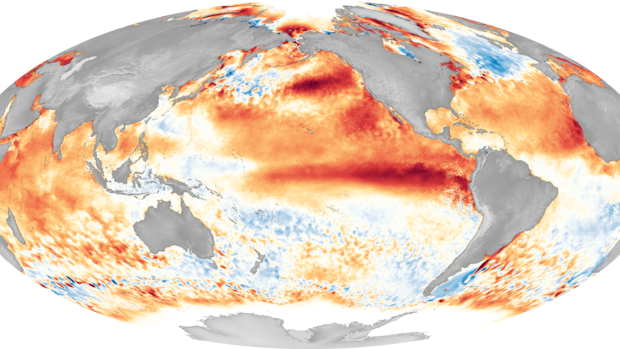

After experiencing La Niña conditions for about 18 months, there are indications that an El Niño event may occur later this year. Early predictions suggest that this potential El Niño could be notably strong, leading to a surge in global temperatures.
La Niña and El Niño are components of the El Niño Southern Oscillation (ENSO), a natural cyclical phenomenon in the Pacific Ocean. La Niña typically brings cooler conditions to the Niño 3.4 region, while El Niño results in warmer temperatures, influencing climate patterns worldwide.
Presently, a La Niña advisory/El Niño watch is in effect, with the expectation of neutral conditions before transitioning to El Niño by summer, according to the National Oceanic and Atmospheric Administration (NOAA). Recent analysis by Zeke Hausfather from Berkeley Earth revealed a likelihood of a strong to potentially “super” El Niño event unfolding later this year, surpassing previous occurrences in 1997-98 and 2015-16.
Although the projected temperature anomaly stands at 2.4°C based on Hausfather’s assessments, these forecasts are preliminary and fall under the “spring unpredictability barrier,” making them less reliable. Climate scientist Daniel Swain also anticipates a robust El Niño, with most models predicting at least moderate strength by late summer.
The potential El Niño event could significantly impact global temperatures, with repercussions on regional weather systems. While most models indicate an El Niño development around June and peaking in November, there have been diverging forecasts, including the Canadian model suggesting some weakening.
If a strong El Niño materializes in 2027, it may surpass 2024 as the hottest year on record, potentially leading to a 1.6°C rise compared to the pre-industrial era. The expected impacts encompass extreme events globally, such as heatwaves, heavy precipitation, droughts, and wildfires, accentuated by the El Niño influence.
As global temperatures escalate, concerns arise about surpassing the 1.5°C warming threshold outlined by the Intergovernmental Panel on Climate Change (IPCC). The past decade has witnessed the hottest years on record, with the last three years exceeding the 1.5°C benchmark. A strong El Niño event offers a glimpse into a potentially alarming future in a warming climate.