
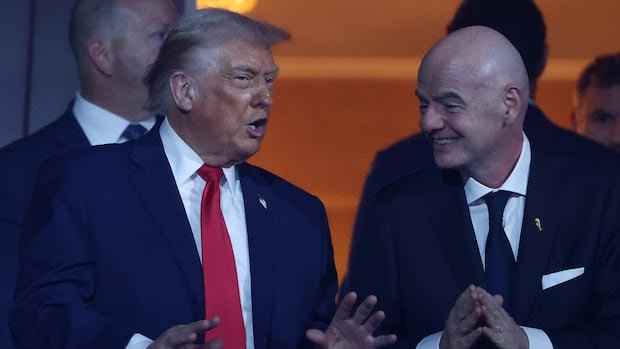

Last week, a global audience witnessed The Village People’s performance of the classic song “YMCA” during the FIFA 2026 Men’s World Cup Draw at the Kennedy Center in Washington, D.C. The event culminated in an unconventional presentation where Donald Trump engaged in what appeared to be a dance routine.
The ceremony featured an awkward display of Trump receiving FIFA’s inaugural “Peace Prize,” which raised concerns due to the involvement of a Myanmar junta crony in the selection process. Subsequently, FIFA President Gianni Infantino faced accusations of violating the organization’s “political neutrality.”
During the draw, Prime Minister Mark Carney, Mexican President Claudia Sheinbaum, and Trump shared the stage with Infantino. Following the allocation of host nations to groups, the event continued with appearances by American athletes rather than soccer legends, with minimal representation of women.
Despite the attempt to incorporate American culture, the revelation of group placements and the upcoming tournament generated significant interest worldwide. The FIFA Men’s World Cup remains a highly anticipated event, with reports indicating over 1.5 billion viewers tuned in to the previous tournament in Qatar.
Soccer holds a special place in global culture, serving as a unifying force across diverse communities. While some view football as a sacred entity with players revered as idols, others see it as a fundamental part of their identity.
In Canada, soccer has garnered increased attention, particularly with the national team demonstrating exceptional talent under American coach Jesse Marsch. The anticipation of hosting matches in Vancouver and Toronto has sparked enthusiasm, as Canada prepares to host a men’s tournament for the first time.
Amid the excitement, concerns arise regarding access to the World Cup for fans from countries facing travel bans, such as Haiti and Iran in the United States. The World Cup traditionally fosters community gatherings where individuals can support their teams collectively, emphasizing the importance of inclusivity and celebration.
However, fears persist regarding potential security threats and discriminatory practices, contrasting FIFA’s “Football Unites the World” campaign. Human rights organizations have called for clear policies to safeguard participants, workers, athletes, and marginalized groups during the tournament.
As the soccer community navigates political complexities intersecting with the sport, unity and advocacy become crucial. While boycotting may not be feasible, fans can play a vital role in promoting fairness and accountability within the game. By using their voices to speak out against injustices, fans can uphold the integrity of soccer and advocate for a more inclusive and equitable environment.