
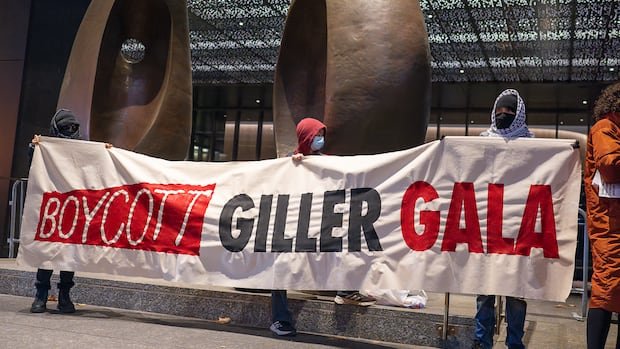

CanLit Responds, a pro-Palestinian group that instigated a collective action against the Giller Prize over a year ago, has declared an end to its boycott of the literary event. The group received confirmation via email from executive director Elana Rabinovitch that the Giller Prize no longer has sponsorship connections with Scotiabank or the Azrieli Foundation. Rabinovitch clarified in the email, shared with The Canadian Press, that the prize’s association with Indigo Books was only as a promotional partner, not a sponsor, as previously thought.
The boycott, initiated by CanLit Responds in the fall of 2024 due to the Giller sponsors’ ties to Israel, garnered support from numerous Canadian authors, including David Bergen, Shani Mootoo, and Thea Lim. Scotiabank had been the naming sponsor of the $100,000 prize for twenty years until protests erupted in 2023 over its subsidiary’s investment in an Israeli arms manufacturer, leading to the Giller Foundation severing ties with the bank last year.
Despite the split with Scotiabank, the boycott continued as CanLit Responds demanded that the Giller Prize not be associated with either Indigo or the Azrieli Foundation. Concerns were raised over Indigo’s CEO running a charity that offers scholarships to former Israel Defence Forces soldiers without family in the country. Additionally, objections were raised against the Azrieli Foundation due to its connection to the Israeli real estate company Azrieli Group, which has holdings in Bank Leumi, listed by the United Nations Human Rights Office for its involvement in settlements in the occupied Palestinian territory.
In response to the boycott and concerns raised, Rabinovitch informed CanLit Responds in a January email that the Giller Prize had never received funds from Indigo and that the book retailer only showcased Giller-nominated works in its stores. The Azrieli Foundation, in a statement on its website, clarified its distinction from the Azrieli Group and reiterated its commitment to supporting arts and culture in Canada.
Heather Sherman, the foundation’s director of communications, clarified that the funding agreement with the Giller Prize had ended as planned after three years and was not terminated due to pressure from activist groups. She expressed the foundation’s openness to future collaborations while emphasizing their ongoing support for arts and culture in Canada.
Rabinovitch further disclosed in her email that the Giller had concluded its contract with the Azrieli Foundation in 2025. She mentioned that for the 2025 prize, the Giller operated with a one-time “bridge” gift and two smaller anonymous donations, enabling the continuation of the prize into 2026.
CanLit Responds hailed the end of their boycott as a significant victory for writers opposed to the normalization of Palestinian genocide. They urged the Giller Prize to ensure transparent and ethical sponsorships in the present and future. Organizer Michael DeForge emphasized that trust rebuilding with writers and readers rests with the Giller Prize, and the participation of authors in the prize remains to be seen.
Canadian writer Andre Forget, a longlisted author for the Giller Prize 2022, expressed willingness to consider submitting future works, contingent on unfolding developments. He acknowledged the challenging nature of the experience and emphasized that rebuilding trust would be a gradual process.
Regulatory filings from February revealed that Scotiabank’s 1832 Asset Management divested its remaining holdings in Israeli defence manufacturer Elbit Systems Ltd. The 2026 Giller Prize longlist announcement is slated for mid-September, followed by the shortlist announcement in early October.