
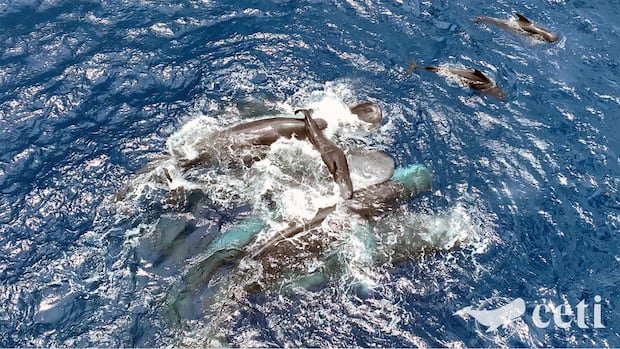

Rare footage capturing a sperm whale’s birthing process has provided scientists with valuable insights into the behavior of these elusive marine mammals. The video, filmed in 2023, showcases female whales from distinct family lines collaborating to assist during the crucial moments of labor and lifting the newborn calf above the water. This exceptional level of coordination is a rarity in the animal kingdom, particularly outside primate species like monkeys and humans. Historically, there have been only a few documented sperm whale births over the past six decades, mostly through anecdotal reports or observations from whaling vessels.
A recent study published in the journal Science recounts this extraordinary event where researchers observed and analyzed drone footage, uncovering indications of cooperation among both related and unrelated sperm whales in aiding newborns. The scientists were studying whale communication off the coast of Dominica on July 8, 2023, when they witnessed a group of 11 whales, predominantly females, engaging in synchronized movements above and below the water’s surface. Subsequently, drones and microphones were deployed to document the event, with the entire delivery process lasting approximately 30 minutes. Following the birth, pairs of whales supported the calf above water until it could swim independently.
The researchers, including study co-author David Gruber from the Cetacean Translation Initiative (Project CETI), were awestruck by the event. They developed software to analyze the collective support provided by numerous female whales, whether related or not, during the birth, showcasing the close-knit, female-led social structure within sperm whale groups. This demonstration of solidarity during such a critical and vulnerable moment left the researchers amazed at the whales’ ability to come together to ensure the newborn’s well-being.
The whales’ vocalizations during the birth, characterized by distinct patterns of clicks, were highlighted in a separate report published in Scientific Reports. These communication cues, akin to a Morse code system, intensified during key birthing moments, potentially aiding coordination efforts among the whales. The researchers speculated that these vocalizations might also serve as a form of celebration, akin to human expressions of joy.
While the newfound insights raise numerous questions about whale behavior and communication, the scarcity of video documentation like this emphasizes the significance of these observations. The researchers hope that these revelations will shed light on the intricate social dynamics of these magnificent marine creatures. Biologist Susan Parks of Syracuse University, not involved in the studies, expressed excitement over the potential discoveries awaiting researchers in decoding the whales’ hidden interactions.
The findings from these studies offer a glimpse into the mysterious world of sperm whales and underline the importance of further exploration into their social lives and communication methods.