
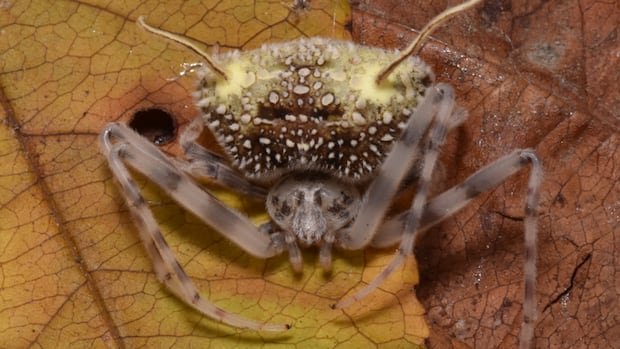

In a surprising encounter during an Amazon rainforest tour in August 2025, scientist Alexander Bentley discovered a spider seemingly alive under a mass covered with what appeared to be a parasitic fungus. Familiar with cordyceps, a notorious parasitic fungus, Bentley was astonished by the spider’s survival despite the fungus’s presence.
This particular spider exhibited tubercles on its abdomen, resembling signs of a cordyceps-infected host. Initially believed to be a cordyceps-infected spider, further examination revealed it to be a newly discovered spider species that mimics fungus like cordyceps, possibly for prey attraction or predator deterrence. The findings were recently published in Zootaxa.
While scientists are excited about this discovery, opinions vary on whether the spider’s resemblance to the fungus is sufficient evidence of mimicry. Bentley consulted iNaturalist, a citizen-science platform, where experts identified the spider as a new species, potentially related to the gibellula parasitic fungi.
Upon collaboration with colleague David Ricardo Díaz-Guevara, Bentley confirmed the spider as a new species, named Taczanowskia waska, through detailed morphological analysis. The unique discovery has garnered praise, highlighting the significance of platforms like iNaturalist for scientific contributions.
Speculation surrounds the reasons for the spider’s mimicry of fungus, with theories suggesting it could serve as a hunting strategy or defense mechanism against predators. While some experts argue that the spider’s appearance may not necessarily be camouflage, the discovery remains unprecedented in the scientific community.
Andrew Swafford, an associate professor of biology, notes the potential groundbreaking nature of this spider’s mimicry behavior, if confirmed. Bentley considers this discovery as one of the most remarkable and rare findings in his extensive rainforest explorations.