
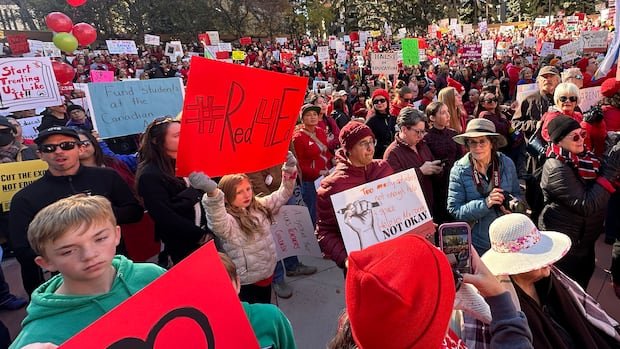

The Alberta Teachers’ Association, representing 51,000 teachers on strike since October 6, has declined a request to return to classrooms voluntarily for talks excluding class-size caps and pupil-teacher ratios. Teachers have been advocating for improved classroom conditions, citing overcrowding and inadequate resources to support students’ needs.
Alberta Premier Danielle Smith mentioned the possibility of introducing legislation to compel teachers back to work if a deal is not reached by the legislative session starting on October 27. The ATA has not indicated whether they would legally challenge any back-to-work legislation.
The government proposed mediation on issues like teacher salaries and classroom complexity, omitting hard caps on class sizes or student-teacher ratios. The ATA expressed concerns over the biased nature of the process and emphasized the need for solutions tailored to Alberta’s education system.
Education Minister Demetrios Nicolaides acknowledged teachers’ concerns and pledged to address issues like class sizes by hiring more staff and building additional schools. Premier Smith criticized the fixation on specific solutions by the ATA, emphasizing the importance of flexibility in staffing decisions for school boards.
Labour relations expert Jason Foster warned that imposing a back-to-work law could lead to long-term resentment among teachers. He suggested that such legislation might mandate a return to work and push for binding arbitration, potentially limiting the issues the arbitrator can address.
In response to the ongoing dispute, Alberta Education announced that November diploma exams would be optional due to the strike. Teachers, who have been without pay during the lockout, seek larger wage increases and measures to address classroom complexities.
Despite rejecting recent contract offers, teachers continue to demand better pay and conditions, highlighting the necessity of legal mechanisms to ensure manageable classroom compositions. The ATA argues that without such provisions, the challenges in classrooms will persist, impacting student learning.
The situation remains unresolved, with the potential for future repercussions on education in Alberta.