
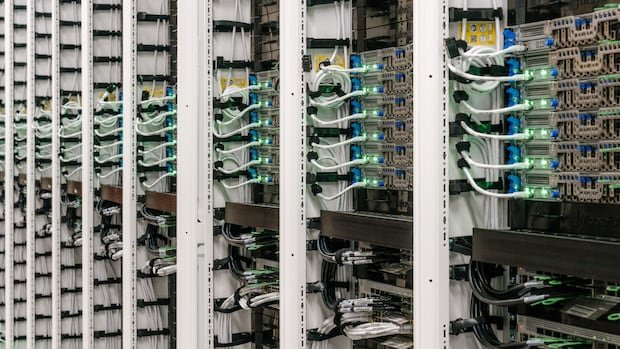

A fresh national AI strategy from the federal government has emerged this week amidst a surge in new high-capacity data centers across the country, raising concerns about the potential negative effects of this advancing technology.
Until now, data centers have largely flown under the radar for many Canadians, but a recent study by York University reveals a significant shift in the landscape. The latest data centers being constructed boast ten times the capacity of their predecessors, sparking worries about the land, water, and energy resources they will consume.
Alberta finds itself at the forefront of this data center expansion, offering ample energy resources, efficient regulations, and governmental support. The research highlights the sector’s rapid expansion, with currently active data centers collectively capable of 1.6 gigawatts, a figure that could soar to 13.2 gigawatts once all proposed projects are realized.
Simultaneously, public skepticism towards these developments is on the rise. According to a recent Angus Reid survey, 68% of respondents would oppose the construction of a large AI data center near their homes, with rural dwellers slightly more resistant at 73% compared to urban residents at 67%.
In response to escalating concerns, Federal AI minister Evan Solomon has emphasized the importance of striking a balance between technological advancement and ensuring safety, fairness, and practicality, countering both staunch critics and those inclined to exaggerate the benefits of AI.
The data center industry is undergoing rapid growth, with traditional facilities typically operating at around five megawatts, while advanced hyperscale data centers fueling the AI boom can demand up to 100 megawatts. Presently, only five hyperscale data centers exist in Canada, with two in British Columbia and the remainder in Ontario, Quebec, and New Brunswick.
However, York University’s research indicates that an additional 96 such facilities are either planned or under construction. These hyperscale centers can be situated farther from urban centers as they are primarily used for AI model training, necessitating access to cheap land, energy, and water resources in rural areas.
The study underscores Alberta’s increasing allure for data center projects due to its deregulated electricity system, cost-effective natural gas-powered electricity, and proactive government initiatives aimed at fostering sector growth by expediting regulatory processes and providing dedicated support to AI data center investors and operators.
Although challenges and concerns persist, data center developers are actively seeking ways to mitigate environmental impacts and enhance efficiency. Strategies include adopting closed-loop water systems akin to car radiators and investing in off-grid power generation to alleviate strain on existing electricity grids. Companies like Microsoft Canada are committed to addressing these challenges by implementing innovative technologies to reduce water usage and minimize environmental footprints.
Alberta’s advantages, such as a robust fiber optic network, skilled workforce, and business-friendly government policies, make it an optimal location for data center development, attracting companies like eStruxture. Despite public apprehensions, industry leaders emphasize the importance of engaging with communities, addressing concerns transparently, and collaborating to find solutions that benefit all stakeholders.