
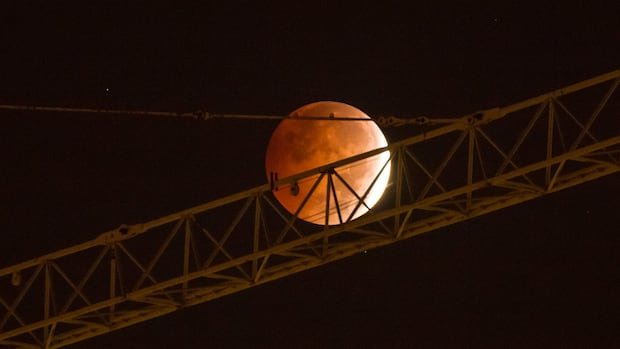

On the night of August 27-28, Canadians will have the opportunity to witness a significant partial lunar eclipse. Following the recent total solar eclipse visible in Iceland, Spain, and parts of Portugal, this lunar eclipse will offer a deep spectacle with approximately 93 percent coverage at its peak.
Lunar eclipses occur when the moon passes through the Earth’s shadow, known as the umbra, after traversing the outer, fainter shadow called the penumbra. While the penumbral phase is harder to perceive with the naked eye due to its dimness, the main event promises a visually striking experience.
Most regions of Canada will have a clear view of the entire eclipse duration, while Western Canada will catch a glimpse of the partial eclipse as the moon ascends in the sky. Unlike solar eclipses that require protective eyewear, lunar eclipses can be safely observed without any special equipment, making it a more accessible astronomical event.
The eclipse will commence as the moon enters Earth’s penumbra around 10 p.m. ET, but the visible phase will start at 10:33 p.m. ET on August 27 and conclude at 1:52 a.m. on August 28. The peak of the eclipse, darkening most of the moon, is expected at 12:13 a.m.
This lunar eclipse is part of a series of celestial events unfolding this month, adding to the astronomical excitement in August. While the eclipse may not result in a fully red “blood moon,” viewers across Canada can anticipate a reddish hue during the event. Observers are encouraged to use binoculars, a small telescope, or a smartphone camera with night mode for capturing clear images of this captivating phenomenon.