
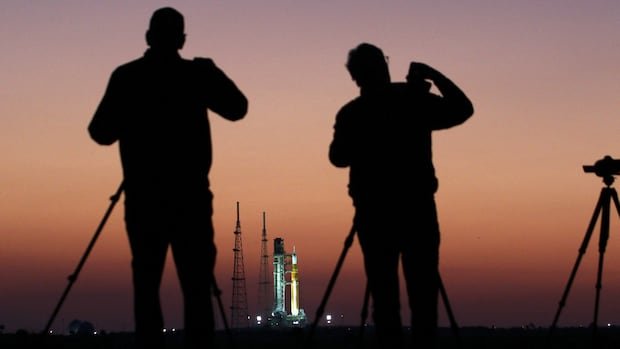

Artemis II is on the brink of embarking on its journey around the moon and back, marking a potentially groundbreaking mission that could propel humans farther into space than ever before. CBC News is gearing up to provide extensive coverage of the voyage, which will see Canadian Space Agency astronaut Jeremy Hansen alongside NASA astronauts Reid Wiseman, Victor Glover, and Christina Koch aboard.
The crew will be embarking on this momentous journey aboard the Space Launch System (SLS) rocket within the confines of the Orion spacecraft, with the launch scheduled from Kennedy Space Center’s Launch Pad 39B in Florida.
Determining the launch date for Artemis II has posed some challenges due to various factors such as risk assessments and system checks. Previous launch attempts in February and March had to be postponed due to hydrogen and helium issues, in addition to weather considerations. However, NASA has indicated an optimistic outlook for an April 1 launch, with an 80% likelihood of a successful liftoff.
The initial launch window is set for Wednesday, April 1, between 6:24 p.m. and 8:24 p.m. ET. Subsequent opportunities will be available every evening from April 2 to April 6 if the launch is delayed for any reason.
To observe the critical minutes leading up to liftoff, NASA offers a detailed breakdown of the countdown process. Those interested in witnessing the launch firsthand are encouraged to be prepared for a nighttime launch, especially for those on the East Coast.
For those eager to stay updated on the mission, CBC’s team of reporters, including Nicole Mortillaro, Paul Hunter, and Karen Pauls, will be stationed at Kennedy Space Center to provide comprehensive coverage across radio, TV, and digital platforms. The online coverage will commence two hours before liftoff on CBCNews.ca, featuring a live stream of the launch and real-time updates on the mission’s progress.
Artemis II’s trajectory involves a lunar orbit without a landing on the moon. This mission serves as a pivotal test for essential systems and their performance with astronauts aboard. Originally intended as a precursor to Artemis III’s lunar landing in 2028, NASA recently altered its plans, with Artemis IV now slated for a lunar surface touchdown.
The Artemis missions aim to establish a sustained human presence, conduct scientific research, and foster economic activities on the moon, with an eye toward future Mars exploration. NASA’s push for lunar exploration also aligns with plans to expedite the establishment of a moon base and forego the interim Lunar Gateway project. This accelerated approach is driven by a desire to revitalize the nation’s space exploration capabilities following delays and to compete with China’s ambitious lunar program.
Artemis II represents a crucial step in NASA’s quest for lunar exploration, with the mission expected to span approximately 10 days before the crew returns to Earth, splashing down in the Pacific Ocean.