
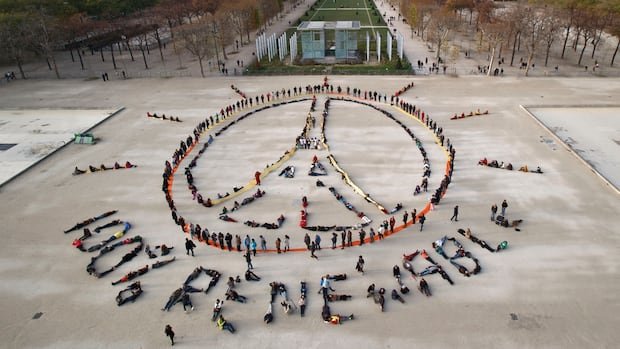

Environmental activists formed a human chain symbolizing peace and spelled out “100% renewable” near the Eiffel Tower during the COP21 UN climate summit in Paris on December 6, 2015. This event marked the signing of the historic Paris Agreement, the first international commitment involving nearly 200 countries to combat climate change. The agreement aimed to limit global warming to “well below” 2 degrees Celsius compared to pre-industrial levels, with efforts to cap it at 1.5 degrees Celsius.
A decade later, the same nations will convene in Belem, Brazil, from November 10 to 21 for the annual United Nations climate summit, COP30. Throughout the past ten years, atmospheric greenhouse gas levels, responsible for climate change, and global temperatures have continued to rise significantly, reaching unprecedented levels.
In terms of climate change progress post-Paris Agreement, a comparison is made between the conditions then and now, focusing on the actual climate, advancements in clean technologies, governmental policies, and financial investments. For instance, global temperatures have increased by 0.3 degrees Celsius since the agreement was signed in December 2015.
According to the 2025 UN Emissions Gap Report, current projections suggest a warming trend of 2.3 degrees Celsius by 2100 if countries fulfill their climate commitments. This would result in a doubling of potentially lethal hot days annually globally. The growth of renewable energy sources has also been notable, with renewables surpassing coal as a primary electricity source during the first half of 2025.
Furthermore, the Paris Agreement has influenced significant changes in laws and regulations worldwide. The agreement has accelerated the adoption of low-carbon technologies and solutions, leading to the implementation of national policies like carbon pricing and net-zero emission goals. However, challenges remain in achieving the agreement’s targets, with suggestions for mandatory climate actions and sector-specific climate progress.
Investment in green energy has exceeded $2 trillion USD in 2024, surpassing fossil fuel investments. The agreement has also emphasized financial assistance from developed countries to aid developing nations in climate change mitigation and adaptation efforts, although adaptation funding fell in 2023.
In conclusion, while the Paris Agreement has shown progress in various aspects, there is a consensus among experts that stronger efforts are needed to achieve its ambitious climate goals. Suggestions include revising trade treaties, focusing on energy transitions, and making climate actions mandatory to expedite global climate action.