
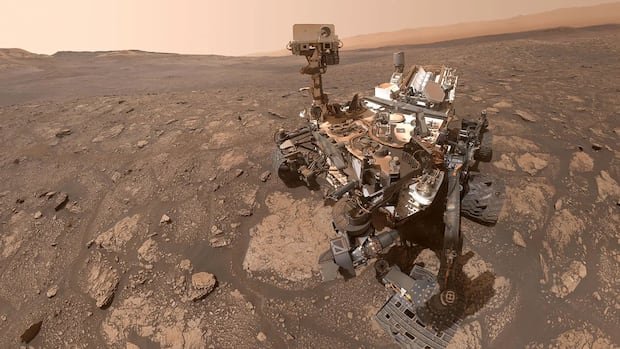

NASA’s Curiosity rover has found additional organic compounds on Mars as researchers investigate the possibility of past life on the Red Planet. Out of the seven diverse organic compounds identified in a rock sample from a dried lakebed near Mars’ equator, five were previously unknown on Mars. The experiment also hinted at the presence of an organic compound similar in structure to DNA precursors, the molecules responsible for genetic information in Earth’s organisms.
These organic compounds, which are essential building blocks of life on Earth, now number in the dozens on Mars. However, scientists caution that these compounds could have formed through nonbiological processes. Mars, like other planets in the solar system, formed around 4.5 billion years ago and was once warmer and wetter before becoming the cold, arid planet it is today. The rock sample analyzed by the rover, deposited by ancient flowing water, is estimated to be at least 3.5 billion years old.
Astrobiologist and planetary scientist Amy Williams from the University of Florida, a member of the Curiosity scientific team, emphasized that while the findings do not definitively prove past Martian life, they do support the idea that Mars was conducive to life around the time Earth’s life began. The rover’s Sample Analysis at Mars (SAM) instrument conducted the experiment by drilling into bedrock at a location named Mary Anning. This study adds to the understanding that Mars had habitable conditions in the past, potentially suitable for microbial life.
Clay minerals present in the region where the experiment took place are known to preserve organic molecules effectively, making them a prime target for such discoveries. The study underscores the importance of Mars’ habitable environments in the ancient past and their potential for hosting life as we know it. Williams emphasized that the Curiosity rover was specifically designed to explore habitable environments on Mars. Further analysis of rock samples may be necessary to definitively identify evidence of past life.
In a separate discovery last year, the Perseverance rover obtained a rock sample from a different crater on Mars that showed features possibly linked to microbial chemical reactions during the rock’s formation. NASA’s ongoing Mars missions, including the exploration of organic compounds, are crucial in unraveling the planet’s history and potential for life. Williams highlighted the significance of current and upcoming rover instruments in detecting complex organic matter that could provide clues about past life on Mars.