
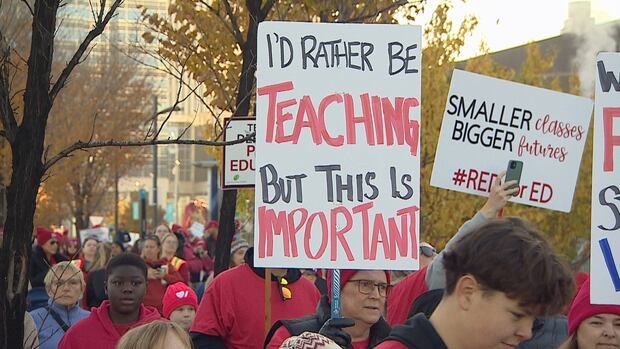

Vehicle horns resounded in downtown Edmonton on Thursday morning as motorists showed support for thousands of educators rallying on Day 11 of the provincewide teachers’ strike. Edmonton police estimated that 8,000 to 10,000 individuals wearing red and carrying signs gathered outside Rogers Place to advocate for public education. Meanwhile, inside the venue, Alberta Premier Danielle Smith delivered a state-of-the-province address to the Edmonton Chamber of Commerce.
Amber Nicholson, an educator and president of Edmonton Catholic Teachers Local 54, expressed that teachers are frustrated and determined to stand up for students. The strike, the first of its kind involving all 51,000 public, Catholic, and francophone school teachers in Alberta, commenced last week following failed negotiations between the province and the teachers’ union.
Finance Minister Nate Horner announced that the Alberta government is considering back-to-work legislation if the strike extends beyond October 27, coinciding with the start of the legislature’s fall session on October 23. Teachers, such as Lee Hrycun from Jasper Place High School, fear the repercussions of being forced back to work, emphasizing the current challenges of overwork and large class sizes.
Premier Smith addressed the potential for back-to-work legislation, highlighting the importance of continuing negotiations to reach a fair settlement. Rally participants emphasized issues such as class sizes and student complexities as key concerns, urging for the hiring of more teachers and smaller class sizes. Students and teachers alike hope for a resolution that addresses these critical issues.
Some teachers cited the lack of support for students with diverse needs, including those who are refugees or learning English as a second language. Premier Smith acknowledged these concerns and hinted at exploring specialized approaches from other jurisdictions, citing Saskatchewan’s successful resolution of similar issues through binding arbitration in 2024.
Drawing on the Saskatchewan example, Smith mentioned the implementation of specialized support classrooms to aid students with complex needs. Conversations with Saskatchewan Premier Scott Moe highlighted the effectiveness of such initiatives in reaching a collective agreement. The ongoing strike in Alberta underscores the urgent need to address classroom challenges and provide adequate support for both students and teachers.