
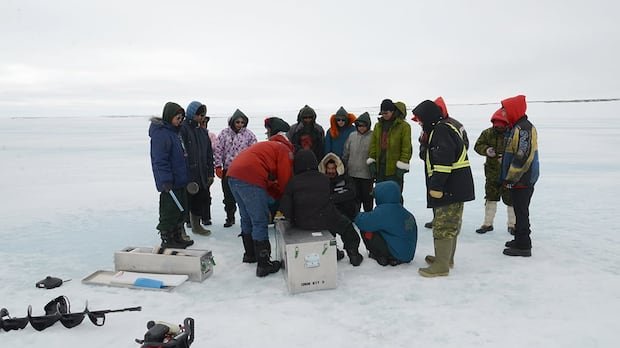

Candice Sudlovenick finds fulfillment in her role as an outreach programs manager at SIKU, reflecting on her past involvement with Ikaarvik as a young individual over a decade ago as instrumental in fostering her passion for research. Sudlovenick expressed how Ikaarvik empowered her, highlighting the realization of her voice and its importance in being heard.
A recent publication in Arctic Science, co-authored by Danielle Nowosad, a postdoctoral fellow at the University of Calgary of Métis heritage, delves into the discussion of Inuit leadership in research methodologies. Nowosad emphasized the growing emphasis in Canada on the inclusion of Indigenous perspectives and knowledge in various domains.
Ikaarvik originated from a group of Inuit youth who completed the Environmental Technology Program at Nunavut Arctic College in Pond Inlet in 2010, aiming to extend their environmental work beyond academic settings. The organization, aptly named after its mission to transform barriers into bridges, focuses on equipping Inuit youth for careers that blend traditional Inuit knowledge with scientific research.
Sudlovenick highlighted the historical challenges in research relationships with communities and the significance of Ikaarvik in advocating for broader roles for Inuit beyond traditional stereotypes. Nowosad underscored the prolonged efforts of Inuit communities to enhance their involvement in research, emphasizing the compatibility of Western science and Inuit Qaujimajatuqangit (IQ), the term for traditional knowledge.
Despite advancements in collaboration, Nowosad and Sudlovenick acknowledged persistent challenges. Nowosad pointed out the mismatch between the timeframes of universities and funding systems, which prioritize rapid outputs, and the slower pace required for community-centric endeavors. She stressed the importance of recognizing the value of lengthier community-based projects for producing robust research outcomes.
With Arctic regions experiencing accelerated climate change, the integration of local knowledge has gained paramount importance. Sudlovenick highlighted the significance of valuing Indigenous knowledge on par with Western science to empower youth in northern communities and promote collaborative efforts for community and environmental betterment. As younger generations grow up immersed in both technology and traditional wisdom, the divide between Western science and Inuit Qaujimajatuqangit is poised to diminish further.