
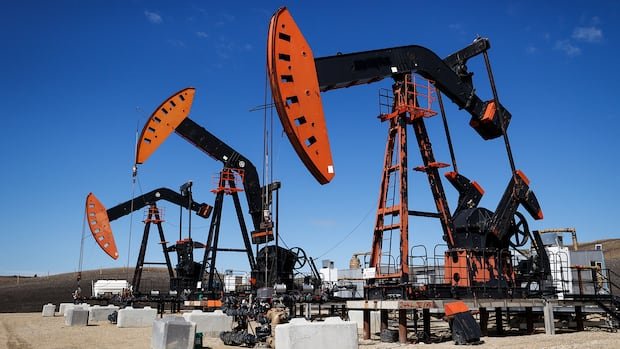

Oil prices experienced a decline on Monday morning following President Donald Trump’s announcement that the United States would refrain from targeting Iran’s energy infrastructure amid ongoing constructive dialogues between the two nations. The price of a barrel of West Texas Intermediate, the primary North American benchmark, dropped by over nine percent to below $90 US, while stock markets saw an initial surge at the opening of trading.
At the close of markets, the S&P 500 soared by 74.52 points to 6,581.00, the Dow rose by 631.00 points, or 1.4 percent, reaching 46,208.47, and the Nasdaq composite surged by 299.15 points, or 1.4 percent, hitting 21,946.76. The S&P/TSX composite index also experienced an increase of 566.40 points, reaching 31,883.81.
President Trump disclosed that he was delaying strikes on Iranian power facilities for a period of five days, citing positive and productive discussions between the two countries aimed at resolving hostilities in the Middle East comprehensively. The escalation in the Middle East conflict has led to a significant surge of approximately 50 percent in oil prices throughout the month.
In contrast to his earlier statements over the weekend, where he threatened further escalation, President Trump warned via Truth Social that unless Iran fully complied by opening the Strait of Hormuz without coercion within 48 hours, the U.S. military would initiate targeting of Iranian power installations, starting with the most significant ones. In response, the Islamic Revolutionary Guard Corps, as broadcasted by Iranian media, declared its intent to “completely close” the Strait of Hormuz should the U.S. proceed with targeting Iranian energy infrastructure.
President Trump outlined military objectives for the Iran conflict, including the degradation or destruction of Iran’s military capabilities, defense infrastructure, and nuclear weapons program, in addition to safeguarding American allies in the region.
The ongoing energy crisis has led to a surge in energy prices over the last three weeks due to Iran’s restrictions on access to the Strait of Hormuz, a vital chokepoint responsible for exporting 20 percent of the world’s oil, along with natural gas and other commodities. Energy analysts from Wood Mackenzie have suggested that the possibility of oil prices reaching $200 per barrel in 2026 is not out of the question in the event of a prolonged disruption to Gulf exports.
Following the resolution of the conflict, the normalization of energy markets may take several months. Kurt Barrow, an oil, fuels, and chemicals analyst at S&P Global, emphasized the need for a few months to restore equilibrium in the system post-conflict. The energy crisis has transitioned into a demand and availability crisis, with a shortfall of around 15 million barrels per day across various oil products.
The North American oil industry is currently grappling with significant uncertainties, with concerns that prolonged high oil prices could lead to a decline in oil demand amidst a potential global recession. Kevin Krausert, CEO of Avatar Innovations and former Alberta drilling executive, underscored the seriousness of the situation within the oil industry, cautioning that while high oil prices may present challenges, they could also have adverse effects on the sector in the long run.
President Trump’s social media post regarding the potential strikes coincided with the fourth week of the conflict with Iran.