
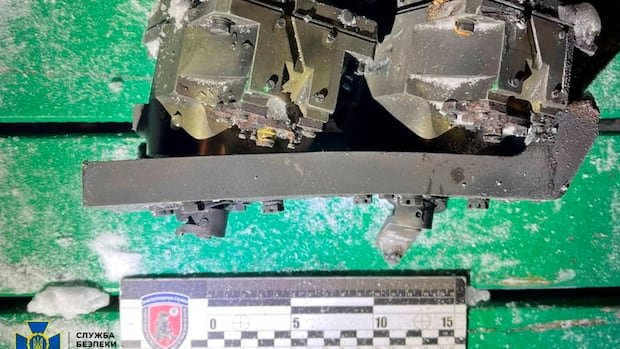

In a recent development, Russia utilized a hypersonic missile to strike a location in western Ukraine near the Polish border within the European Union. Following the missile launch, senior officials publicly extolled the power of this nuclear-capable weapon, sending what some interpreted as a direct message to Western nations. Ukraine’s air force confirmed the missile’s incredible speed of 13,000 kilometers per hour but did not provide specific details on the target.
This incident marked the second deployment of the Oreshnik hypersonic missile by Russia against Ukraine, a weapon deemed impervious to interception by the targeted country. Despite Russia’s utilization of various lethal armaments, including ballistic missiles and drones, observers suggest that the motives behind these actions are more aligned with political communication rather than military strategy.
Former Russian President Dmitry Medvedev, now serving as the deputy chairman of the country’s security council, likened the Oreshnik strike to a necessary antidote in a world he described as influenced by “unstable actors” and “dangerous psychotics.” Medvedev also criticized the alleged “abduction” of Venezuelan leader Nicolás Maduro and the seizure of a Russian-flagged shadow fleet tanker in a social media post on Telegram.
International leaders, including those from the U.K., France, Germany, and Canada, condemned Russia’s use of the missile, labeling it a significant and perilous escalation. EU foreign policy chief Kaja Kallas interpreted the missile launch as a cautionary signal directed at the United States and Europe.
Meanwhile, residents of Kyiv expressed concerns over the ongoing threat posed by Shahed drones targeting the capital. Some locals, like Oleksandr Poliak, regarded the Oreshnik missile as more of a propaganda tool, emphasizing the greater immediacy of addressing the drone attacks routinely faced by the city.
The Oreshnik missile, rarely deployed due to its nuclear capabilities, was reportedly launched by Russia as a retaliatory measure against an alleged drone attack on President Vladimir Putin’s residence. While Ukraine refuted these claims as baseless, the United States dismissed the reported incident as non-existent. The missile was first used by Russia in November 2024 against an industrial site in Dnipro.
Experts underscore the unique features of the Oreshnik missile, notably its hypersonic speed and the ability to carry six warheads with individual submunitions for targeting multiple objectives. The weapon’s operational phases involve a boost phase, separation in space, and the release of warheads, making interception by Ukraine extremely challenging due to the lack of hypersonic interceptors.
The recent deployment of the Oreshnik missile by Russia is believed to be a strategic message aimed at Ukraine’s allies, signaling the weapon’s potential reach and impact. Observers speculate that Russia’s choice to use this advanced weapon serves more as a political statement rather than a tactical military move.