
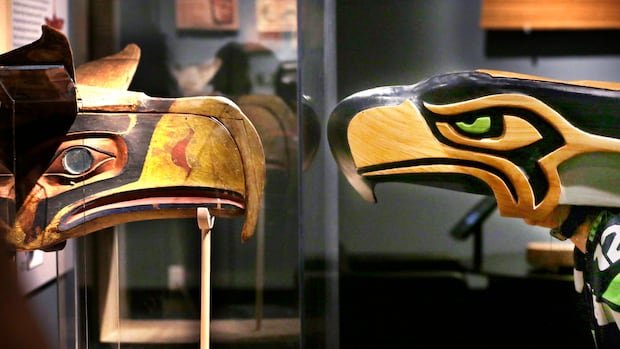

More than ten years ago, during the Seattle Seahawks’ initial Super Bowl appearances, Robin K. Wright, a former professor at the University of Washington, shared an interesting anecdote about her art history students’ fascination with the NFL team’s logo. Wright explained that the inspiration behind the Seahawks’ logo, featuring a raptor profile, stemmed from a Kwakwakaʼwakw transformation mask from northern Vancouver Island.
The mask, resembling a raptor when closed and revealing a human face when open, was initially unnoticed due to its display style. Despite Seattle being on Coast Salish territory, the logo drew inspiration from the Kwakwakaʼwakw territory’s art style, as explained by Wright.
Before the Seahawks’ 2014 Super Bowl victory, Wright highlighted the potential connection between the team’s logo and the Kwakwaka’wakw mask in a blog post. Initially uncertain of the mask’s location, she later discovered it at the Hudson Museum at the University of Maine. The mask was eventually transferred to the Burke Museum in Seattle for display.
Renowned artist Bruce Alfred, from the ‘Namgis First Nation, confirmed the mask’s authenticity, noting its distinct Kwakwaka’wakw origins. Alfred estimated the mask’s creation date to be around the 1860s or ’70s.
The Seahawks logo, which has undergone redesigns since its 1975 debut, drew initial criticism for its lack of sensitivity to Northwest Coast Indian art principles. Despite its origins and modifications based on a mask in a book, there were no consultations with the Kwakwaka’wakw community during the logo’s design process.
Local Indigenous artists, including Andy Everson and Qualsius, have reinterpreted the logo over the years, incorporating Coast Salish and Kwakwaka’wakw designs. The Seahawks later collaborated with the Muckleshoot Indian Tribe to create T-shirts inspired by the logo using Coast Salish elements.
Wright’s research traced the mask back to Max Ernst, a German surrealist artist, shedding light on the European surrealists’ obsession with Northwest Coast masks. A documentary in 2024 delved into the complex history of these masks and their appropriation.
The significance of transformation masks in Indigenous culture is paramount, as they hold deep cultural meanings. Bunn-Marcuse emphasized the importance of introducing the rich history of Northwest Coast art to a broader audience, even if through unexpected avenues like the NFL.
This unique intersection of art, culture, and sports underscores the enduring legacy and intricate connections between Indigenous heritage and mainstream representations.